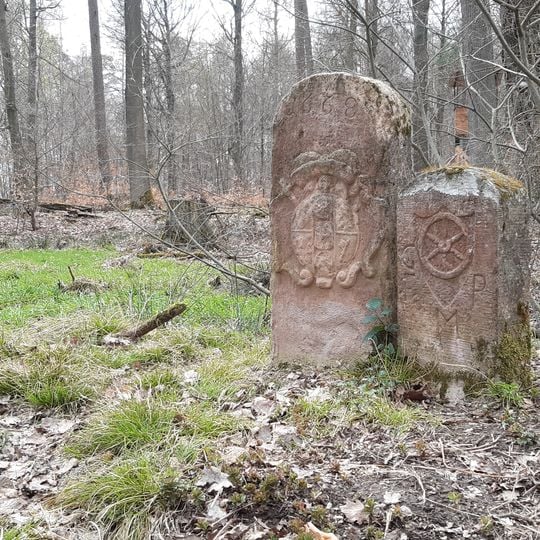
Hoher Stein, Boundary marker at state border between Bavaria and Hesse, Germany
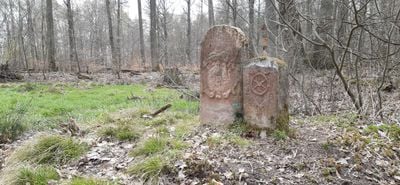
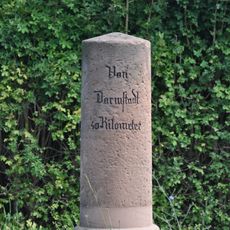
Hoher Stein is a boundary marker on the 281-metre Grenzberg, a sandstone ridge on the Bavarian-Hessian border. The taller, rounded stone bears the year 1668 and a carved crest held by two figures; the shorter stone beside it shows a circle crossed by a diagonal line with the letters L, P, R and M. Both are greyish-brown, rough and moss-covered.
The stone was erected in 1668 to mark the boundaries between three territories: the Archbishopric of Mainz, the Breuberg Lordship, and the Condominium of Umstadt. This boundary point endured for centuries despite shifting political powers in the region.
The larger stone's east face carries the arms of Archbishop Johann Philipp von Schönborn, with the Schönborn lion in a heart shield, the Mainz wheel, the Franconian rake and the Worms key; crossed crozier and sword protrude from the baroque crest. The west face shows the condominium arms of the Palatinate and Hesse-Darmstadt. The smaller stone bears a circle crossed by a diagonal line with the letters L, P, R and M.
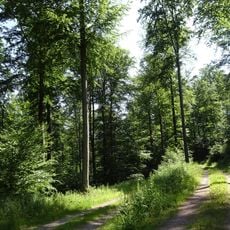
The stones stand on the flattened plateau of the 281-metre Grenzberg, on the Hessian-Bavarian border; the L 3413 between Wald-Amorbach and Hainstadt passes to the west, and an older forest road crosses the eastern pass. The Starkenburger Klettersteig, laid out in 1984, runs south of the stones through old Hainstadt sandstone quarries. A few metres west lies the Bingerloch, a sandstone doline.
The smaller stone's face shows a circle crossed by a diagonal line with the letters L, P, R and M around it, not a Mainz wheel. The survey point on the border mountain carries the number 281, the same figure as the mountain's height in metres.
The community of curious travelers
AroundUs brings together thousands of curated places, local tips, and hidden gems, enriched daily by 94,391 contributors worldwide.