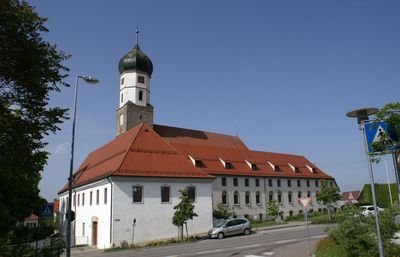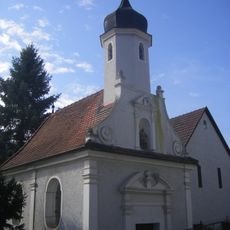
Liebfrauenkirche, Catholic pilgrimage church in Ehingen, Germany
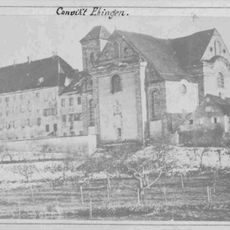
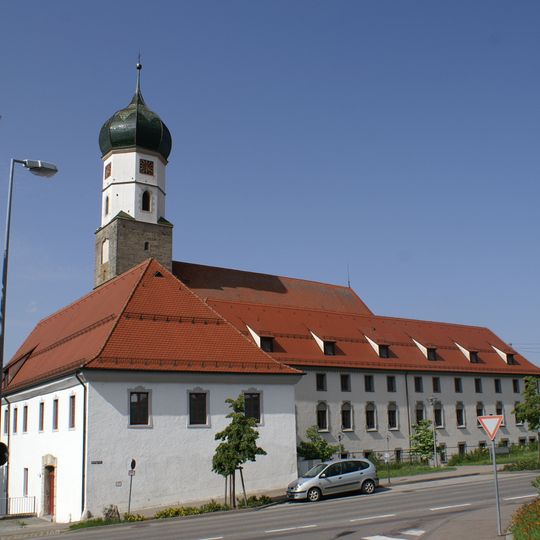
The Liebfrauenkirche is a Baroque hall church built in 1723–1725 on the foundations of a Gothic predecessor, with a nave, a recessed rounded choir to the east and a tower to the west. The nave is covered by a groin-vaulted ceiling, the tower's ground floor by a star vault. The high altar, donated in 1726, is flanked by statues of Saint Joseph and Saint Joachim and holds a Madonna carved in 1440/50 from the Multscher school.
The church was first recorded around 1239 and underwent a major rebuild into a Gothic hall church in 1454. In 1638, Franciscan monks took over the building, establishing it as an important pilgrimage destination that drew visitors for generations.
The church is a filial church of the parish of St. Blaise. Its pilgrimage role centres on the Gnadenbild, a Madonna carved in 1440/50 in the Multscher school, displayed on the high altar donated in 1726 and flanked by statues of St. Joseph and St. Joachim. The Franciscans, who took over the building in 1638, shaped its use as a monastery church until 1812.
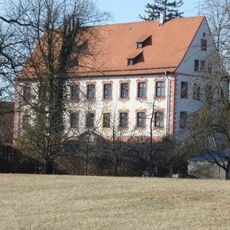
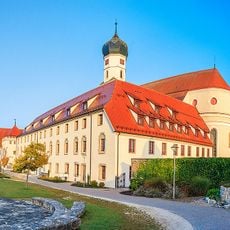
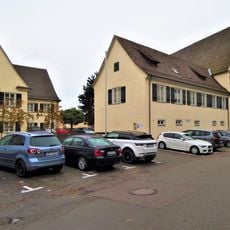
The church stands in Ehingen's old town, with the tower and vestibule at the west end and the rounded choir facing east. The organ loft above the entrance is reached by the upper of two galleries. The former Franciscan monastery next door served as a hospital from 1825 and has housed a cultural centre since 1984.
The church's organ, built in 1886 by the Gebr. Link workshop of Giengen, was never serviced or maintained, so a six-month restoration by Orgelbau Wiedenmann became necessary in 2003. The instrument has 16 stops on two manuals and pedal and stands on the upper of two galleries above the entrance.
The community of curious travelers
AroundUs brings together thousands of curated places, local tips, and hidden gems, enriched daily by 93,608 contributors worldwide.