Preußendenkmal, Historical monument in Ibbenbüren, Germany.
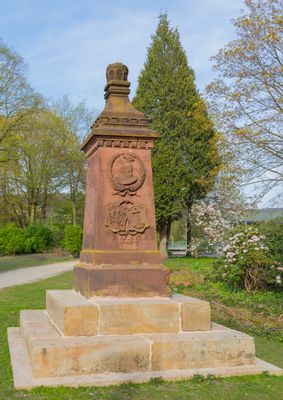
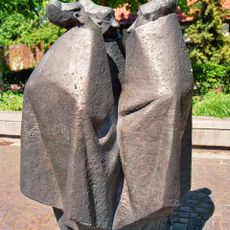
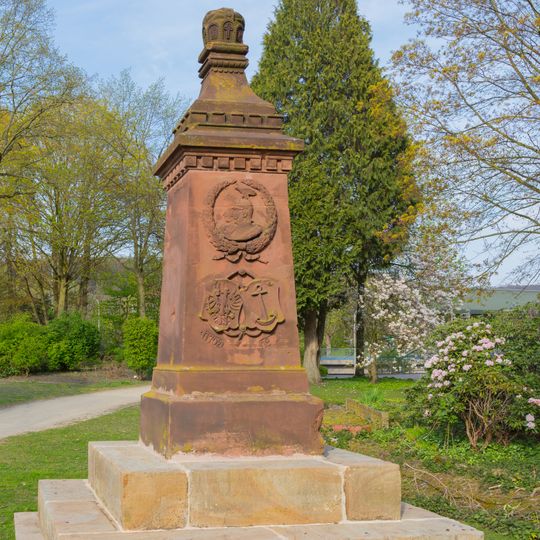
The Preußendenkmal is a three-metre-high monument of red Weser sandstone, carved by Münster sculptor August Schmiemann and unveiled in 1902. Its front shows Ibbenbüren's coat of arms, a golden anchor on blue, beside the Prussian eagle and the years 1702 and 1902. Above them sit wreath-framed medallions of Prussia's first king and Kaiser Wilhelm II, topped by a crown.
The monument was unveiled on 22 May 1902 at the site of the former pump well on the Upper Market, after a festival committee chaired by Amtmann von Eichstedt prepared the celebrations. It commemorates 200 years of the Obergrafschaft Lingen belonging to the Kingdom of Prussia, dated on the monument as 1702 to 1902. In 1924 it was moved to Münsterstraße in front of the Werthmühle, in 1984 to the new market square, and on 29 March 2019 to Heldermannpark.
The monument displays the emblems of Ibbenbüren with a golden anchor on a blue background alongside the Prussian eagle. These symbols reflect the city's connection to its Prussian past and remain visible on the sandstone structure today.
The monument stands in Heldermannpark since 29 March 2019, its fourth location after the Upper Market, Münsterstraße and Neumarkt. It is freely accessible outdoors; the three-metre sandstone stele is best viewed from the front, where the coats of arms and the two date figures 1702 and 1902 face the viewer.
The rear inscription names the donor: "Errichtet von dem Amte Ibbenbüren zur Erinnerung an die Feier der 200-jährigen Zugehörigkeit der Obergrafschaft Lingen zum Königreich Preußen." The stone itself is disputed: the Lower Monument Authority says red Weser sandstone from Bad Karlshafen, the Tecklenburger Kreisblatt reported weather-resistant Eifel sandstone.
The community of curious travelers
AroundUs brings together thousands of curated places, local tips, and hidden gems, enriched daily by 93,962 contributors worldwide.