Denser See, Sinkhole and still waters in Hersfeld-Rotenburg, Germany
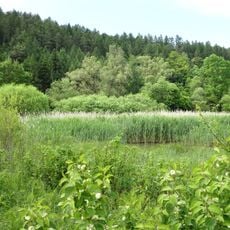
Denser See is a water-filled doline east of the main road in Dens, a district of Nentershausen in the Hersfeld-Rotenburg district. It formed when soluble salt and gypsum layers of the Zechstein beneath the surface were washed out, the overlying rock collapsed, and the depression filled with water. Its length varies between 80 and 140 metres, its width between 50 and 80 metres, and its depth between 2 and 17 metres; it has no above-ground inflow or outflow. In the photograph the olive-green water lies edged by wet earth and low grass, with dense shrubs and trees along the far bank.
Denser See is a water-filled doline, a collapse hollow formed when soluble salt and gypsum layers of the Zechstein beneath the surface were washed out and the overlying rock subsided. Such dolines, locally called Kauten or Kutten, are common in this part of the Richelsdorfer Gebirge. The basin has no above-ground inflow or outflow; its level has been recorded both so low that the remaining water could be covered with a barn door and so high that it overflowed toward the road.
The lake's name is tied to Dens, the Nentershausen district beside it. Its red water, recorded in 1604, 1605 and 1620 by pastor Friedrich Lucae and in the Dens parish chronicles from 1769 to 1928, fed a legend of a drowned rider; the Brothers Grimm collected a tale of two dancers vanishing into the "strange pond". Swimming lessons began in 1926, and a school swimming festival followed in 1928.
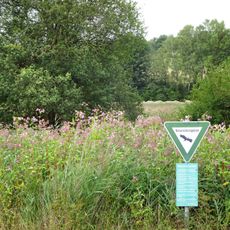
The lake lies east of the main road in Dens, a district of Nentershausen. A display board on the north bank, set up by the Geo-Naturpark Frau-Holle-Land and the municipality, gives the lake's changing dimensions: 80 to 140 metres long, 50 to 80 metres wide, 2 to 17 metres deep. The water has no above-ground inflow or outflow, so its level rises and falls; it has reportedly overflowed toward the road.
The red colouring that sometimes tints the water was traced by hydrogeographer Wilhelm Halbfaß to Daphnia, water fleas one to five millimetres long that rise from the deeper water in autumn and winter; after a hard winter their dead bodies form a red layer on the surface. Dead diatoms or material washed in by underwater springs from the copper and cobalt deposits of the Richelsdorf hills may also play a part.
The community of curious travelers
AroundUs brings together thousands of curated places, local tips, and hidden gems, enriched daily by 93,143 contributors worldwide.