Ristedter Windmühle, Heritage windmill in Ristedt, Germany.
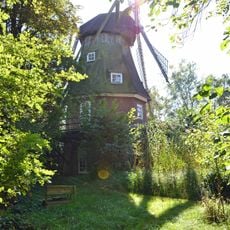
Ristedter Windmühle is a 27-metre-high gallery Dutch mill built in 1880 on the 41.5-metre Blohmberg between Ristedt and Bradenholz. Its brick walls were painted white in 1973. The gallery, sails and wind rose were dismantled after 1965; the building now contains a flat.
A windmill burned down on the 41.5-metre Blohmberg in 1866; the wealthy farming family Wienberg built this gallery Dutch mill there in 1880. In 1931 they fitted Kurt Bilau's Ventikanten, bulbous sheet-metal plates on the sails, which gave two to three times the wind yield and smoother running, drawing visitors and press coverage. A sail damaged by aircraft fire in 1943 was removed in 1952, and the mill was shut down in 1965.
The mill's name Wienbergsche Windmühle comes from the farming family that built it in 1880 and ran it for generations. In 1943 Luise Wienberg passed the Müllermeister examination, the second woman in Germany to do so. The building now holds a flat, so the mill's working life survives mainly in such records and in the white 27-metre tower itself.
The building has been converted into a residential home, so visits involve viewing the mill's exterior to appreciate its historical form and structure. Its hillside location makes it easily visible from the village and simple to locate.
Luise Wienberg passed the miller master examination in 1943, becoming only the second woman in Germany to hold that title. The mill had already drawn nationwide attention in 1931, when the Wienberg family fitted Bilau's curved sheet-metal blades and newspapers and radio reported on the two- to threefold gain in wind output.
The community of curious travelers
AroundUs brings together thousands of curated places, local tips, and hidden gems, enriched daily by 92,795 contributors worldwide.