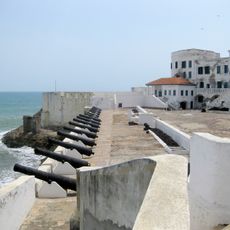
Fort William, British colonial fort in Anomabu, Ghana.
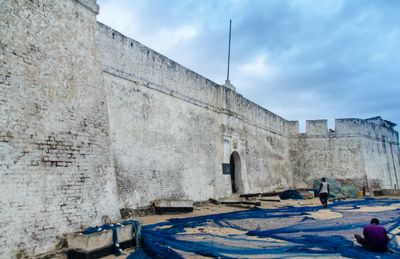
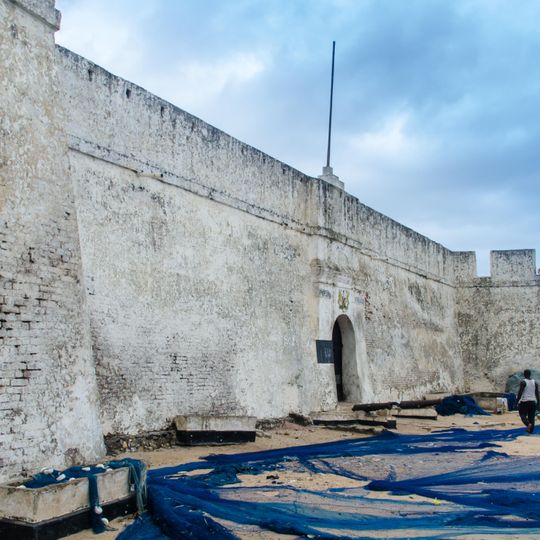
Fort William is a whitewashed stone-and-brick fort in Anomabu, its long wall pierced by an arched doorway bearing a crest and a plaque marked "1482". The British began building it in 1753 to a design by military engineer John Apperly, and Richard Brew completed it in 1760. Brodie Cruickshank added a storey to the main building in the 1830s.
This fort was built in 1753 following the destruction of an earlier structure to prevent foreign control of the site. Structural modifications in the 1830s gave it the name it carries today.
The fort's name comes from King William IV, after commander Brodie Cruickshank added a storey and renamed it in the 1830s; before that it was Fort Anomabo. Two of its documented residents were Venture Smith and William Ansah Sessarakoo, both connected to the Atlantic slave trade. Visitors can still see the well-preserved remains of the fort.
Fort William stands at the eastern end of Anomabu, about 12 km east of Cape Coast along the coastal road, and is reached on foot from the town centre. The arched entrance bears the date 1482 above the door, and low stone blocks lie along the base of the whitewashed wall. Visitors walk through the courtyard and upper rooms; the ground is uneven, so sturdy shoes help.
The fort was originally known by a different name and was renamed after an English monarch, reflecting its complex past. This renaming shows how colonial power was expressed even through the naming of locations.
The community of curious travelers
AroundUs brings together thousands of curated places, local tips, and hidden gems, enriched daily by 92,949 contributors worldwide.