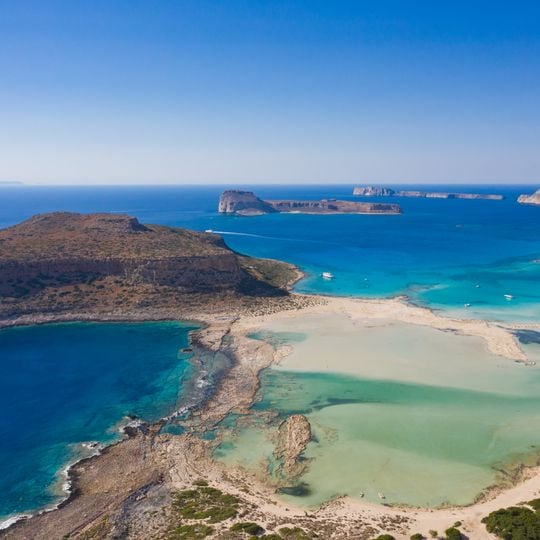
Balos Lagoon, Lagoon and beach in Kissamos Municipality, Greece
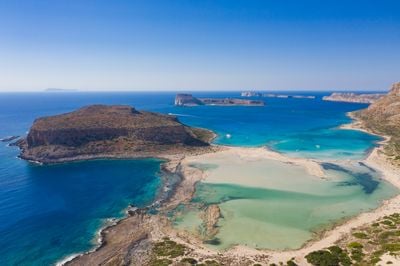
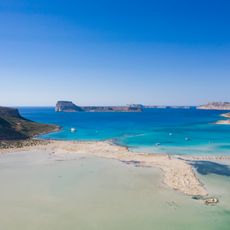
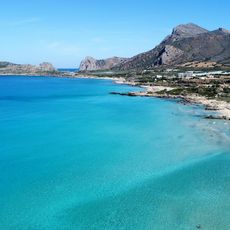
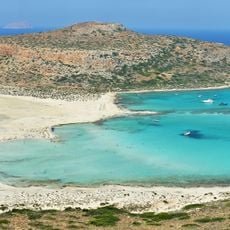
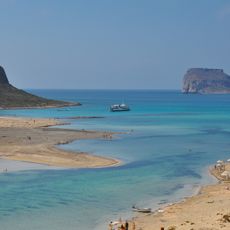
Balos Lagoon is a shallow lagoon with white sand beaches and turquoise water that forms a natural pool between two rocky capes. The water stretches across a wide area, creating a protected zone with gentle sandbars and gradual depth.
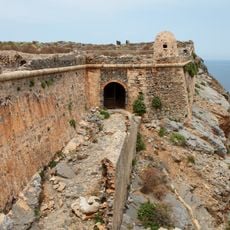
The lagoon formed when the western part of Crete was gradually lifted by tectonic movement, joining the former island of Cape Tigani to the Gramvousa peninsula; two sand spits about 400 metres long now enclose it. On the offshore island of Imeri Gramvousa stand the ruins of a 16th-century Venetian fortress, and a small chapel sits on the heights of Cape Tigani.
The lagoon lies off the uninhabited Gramvousa peninsula, and the name Balos is used for both the bay and the lagoon. On the heights of Cape Tigani stands a small chapel, while the offshore island of Imeri Gramvousa holds the ruins of a 16th-century Venetian fortress. A taverna at the lagoon's southern edge opens in summer and closes in October.
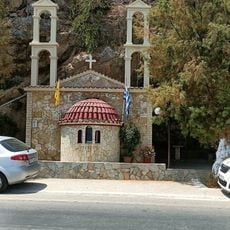
An 8 km unpaved track leaves the asphalt behind Kaliviani and runs north along the east side of the Gramvousa peninsula, passing the chapel of Agia Irini halfway. It ends at a car park about 100 m above sea level, often full by midday in summer; from there a partly stepped path descends roughly 30 minutes to the lagoon. Boats from Kissamos run daily from late April to late October and also call at Imeri Gramvousa.
The shallow water of the lagoon, mostly under 50 cm deep, has no plant growth at all, so the pale sand and rocky patches beneath show through directly. The flat land bridge to Cape Tigani is made of natural cement, cemented sand layers with water holes formed in it.
The community of curious travelers
AroundUs brings together thousands of curated places, local tips, and hidden gems, enriched daily by 92,890 contributors worldwide.