Temple of Olympian Zeus, Ancient Greek temple in central Athens, Greece
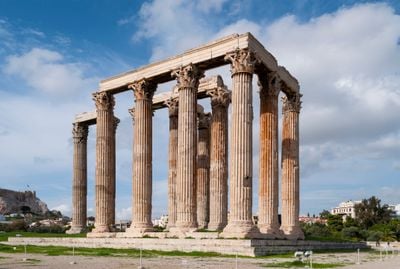
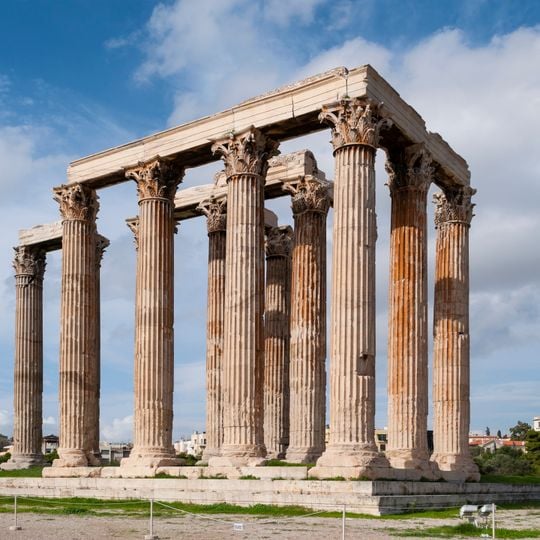
The Temple of Olympian Zeus is a ruined ancient Greek temple in central Athens, about 500 m southeast of the Acropolis. Of its 104 Corinthian columns, each 17 m high and 2.6 m in diameter, 16 survive; 13 still stand on the east side, while one toppled column lies where it fell on the west. The columns are Pentelic marble, fluted, with carved acanthus capitals, resting on a low stepped platform.
Construction began around 520 BC under the sons of the tyrant Peisistratus, Hippias and Hipparchos, and was abandoned when Hippias was expelled in 510 BC. The Seleucid king Antiochus IV revived the project in 174 BC with the Roman architect Decimus Cossutius, who switched the design to Corinthian Pentelic marble and 104 columns. Sulla took some unfinished columns to Rome in 86 BC, and Hadrian finally dedicated the temple in 132 AD, taking the title Panhellenios.
The temple was dedicated to Zeus, chief god of Greek mythology, and its Pentelic marble columns display the Corinthian style with elaborately carved capitals. Visitors can walk among the remains and see how the monumental architecture once demonstrated the power of Athens and Rome.
The archaeological site opens daily for visitors and lies just a five-minute walk from Akropoli metro station. Visitor numbers are lower in early morning or late afternoon, and the light falls especially well on the columns at those times.
A sixteenth column has lain on the ground since a storm in 1852, and the individual marble blocks are still arranged in their original order. Visitors can examine the construction technique up close and see how the drums were stacked without mortar.
The community of curious travelers
AroundUs brings together thousands of curated places, local tips, and hidden gems, enriched daily by 92,753 contributors worldwide.