Archaeological Museum of Paros, Archaeological museum in Parikia, Greece
The Archaeological Museum of Paros occupies two wings that close a large courtyard on the south and east, linked by a portico whose northern half was walled in the 1970s. Room A holds Archaic and Classical sculptures; Room B pottery and small finds from Neolithic to Roman times. The courtyard displays funerary stelae, marble urns, sarcophagi and a Roman mosaic floor.
The museum was founded in 1960 to display artifacts that had been stored for years in the Monastery of Panagia Ekatontapiliani. Over time, it expanded to accommodate more discoveries from the ancient island across its different periods.
The courtyard holds sarcophagi called "anthropomorphic" or "Phoenician", unique in Greece and dating to the Archaic period; they are probably Greek work, though a Phoenician workshop is not excluded, and they attest to links between Paros and the ancient Near East. A stele inscribed "ΟPOΣ ΠΟΛΕΩΣ" marked the city's ancient limits in the 5th century BC, and five stelae with "ΟPOΣ XΩPIO IEPO - AΠOΛΛONΩΣ ΔHΛIO" marked the sanctuary of Delian Apollo.
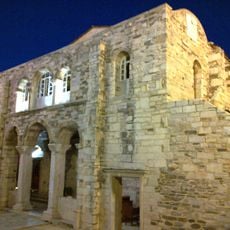
The museum stands slightly uphill from the port, along the pedestrian street climbing from the harbour; the low west wall of the courtyard opens onto a view of Parikia and the Panagia Ekatontapiliani basilica. The two wings are not directly connected but joined by a portico, whose northern half was closed in the 1970s. Visitor numbers peak between May and September.
The museum holds finds from Saliagos, the oldest Neolithic site in the Cyclades, occupied in the 5th and 4th millennia BC. Among them is a small clay figure of a seated, fleshy woman, one of the earliest known Cycladic sculptures. The rest of the collection comes largely from excavations on Paros and neighbouring Antiparos, much of it carved in Parian marble.
The community of curious travelers
AroundUs brings together thousands of curated places, local tips, and hidden gems, enriched daily by 93,292 contributors worldwide.