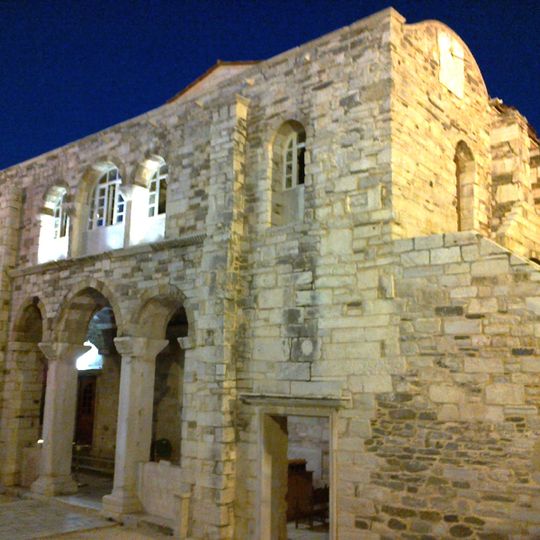
Panagia Ekatontapiliani church, Byzantine church in Parikia, Greece.
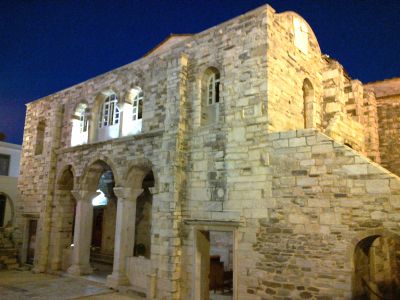
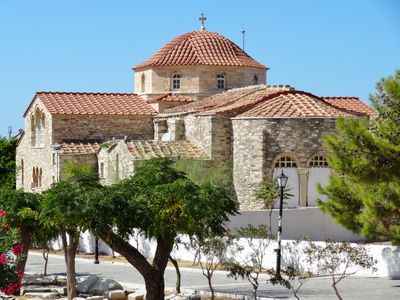
Panagia Ekatontapiliani is a Byzantine church complex in Parikia, Paros, built of light beige and grey stone blocks. Its highest part is a central dome with a red terracotta tiled roof and a small stone cross; lower sections with red tiled roofs extend to the sides. The facade has a two-storey trilobed portal with three recessed arches, and the courtyard contains columns and marble pieces from a former purification fountain.
The church was founded in 326 CE when Saint Helen visited the island during her pilgrimage to the Holy Land. Emperor Justinian's reign in the 6th century brought major reconstruction that shaped its present structure.
The name Ekatontapiliani means "church with a hundred gates", though only 99 doors are counted; tradition holds that the hundredth will appear when Hagia Sophia in Constantinople becomes Orthodox again. The complex also keeps the tomb of Osia Theoktiste, a 9th-century hermit who lived and died in the church.
The complex is entered through a large central iron door that leads into an atrium; from there the two-storey three-lobed facade of the main church faces the visitor. The site lies in the lower part of Parikia, close to the port, so it can be reached on foot from the ferry quay. Several chapels and the baptistery stand apart from the main nave, so allow time to walk between them.
The name Ekatontapiliani means "church of a hundred gates", yet only 99 are counted; tradition holds that the hundredth stays hidden until Hagia Sophia in Constantinople is again used for Orthodox worship. The epithet echoes the "hundred-gated Thebes" sung by Aeschylus and named by Homer.
The community of curious travelers
AroundUs brings together thousands of curated places, local tips, and hidden gems, enriched daily by 94,334 contributors worldwide.