Cave of the Apocalypse, Sacred cave in Patmos, Greece
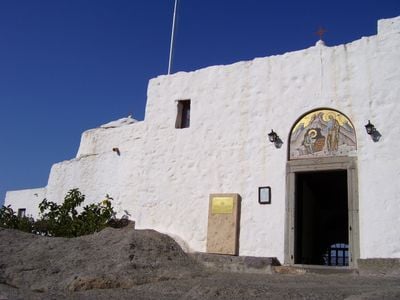
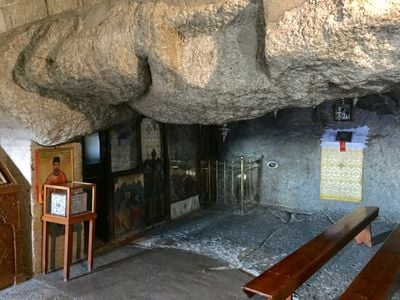
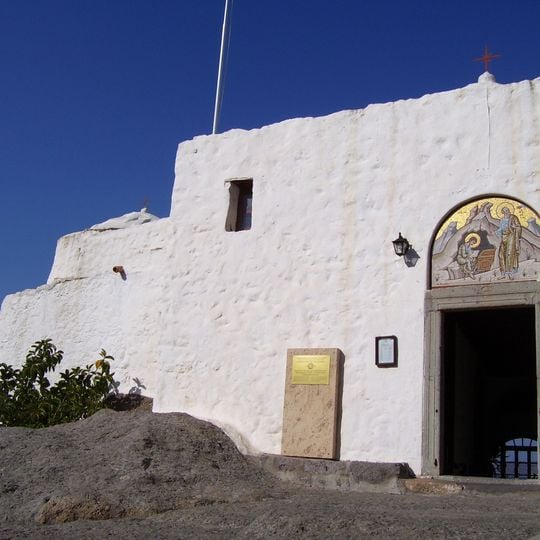
The Cave of the Apocalypse is a grotto about halfway up the mountain on Patmos, on the road between Chóra and Skala. A whitewashed stone chapel with an arched doorway, a mosaic of two figures flanking a chest and a cross above the arch stands at the entrance. Inside, a rough grey rock ceiling overhangs an uneven stone floor; a low barred gate with a cross on top encloses a recess at the back, and framed paintings and painted panels stand against the rock.
Roman authorities exiled John of Patmos to the island in the 1st century under Domitian, and there, with his scribe Prochorus, he received the visions recorded in the Book of Revelation. In 1088 Emperor Alexios Komnenos gave Patmos to the priest John Christodoulos, who built the Monastery of Saint John the Theologian on the island's highest point within about three years. UNESCO listed the cave and monastery together in 1999.
Orthodox pilgrims regularly visit this grotto and kneel before the niches in the rock wall where John is believed to have prayed and slept. Wall paintings and votive offerings cover the interior surfaces, a sign of the devotion that has shaped the site for centuries and remains active today.
The grotto lies about halfway up the mountain on the road linking Chóra and Skala, and is reached by a driveway that runs across the island. Inside, the floor is uneven grey stone beneath a rough rock ceiling, and a low metal gate of vertical bars with a cross on top encloses the recess at the back. Visitors step carefully on the uneven ground and keep to the marked area around the gate.
A silver lamp hangs from the ceiling below the fissures and burns without interruption, a custom that symbolizes perpetual prayer. Some visitors place their hand on the rock ledge that tradition describes as John's headrest during sleep.
The community of curious travelers
AroundUs brings together thousands of curated places, local tips, and hidden gems, enriched daily by 94,118 contributors worldwide.