Rocca a Mare, Sea fort at Heraklion Harbor, Greece
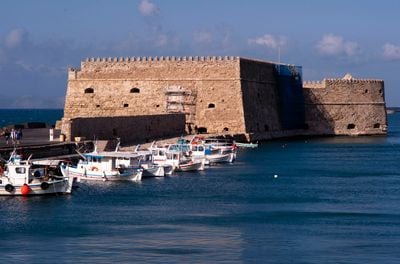
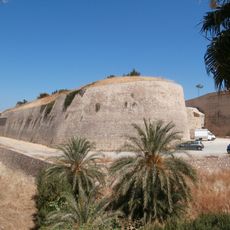
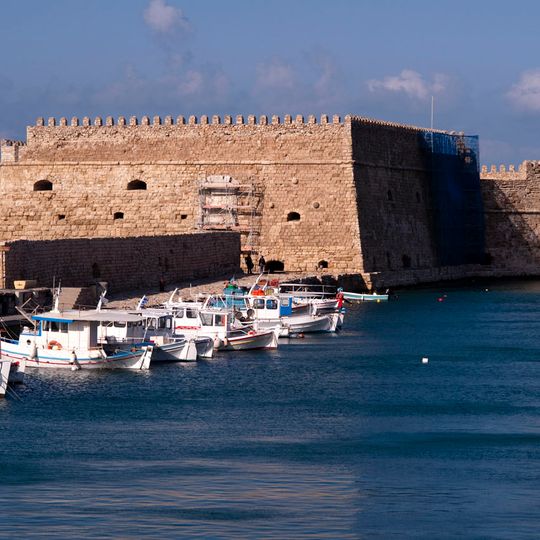
Koules, also called Castello a Mare, is a sea fort at the entrance of Heraklion's old port, built of rough sandy-coloured stone blocks rising straight from the water. Its long facade carries a continuous row of crenellations, with two small dark arched openings midway up the left section. The fort has two parts, a high rectangular section and a slightly lower semi-elliptical one, with walls up to 8.7 m thick and three entrances.
The fortress was built between 1523 and 1540 by Venetian engineers as a defensive structure against naval attacks and pirate raids. It served as a key part of the harbor's protection system during the period of Venetian control over Crete.
A large white relief of the Lion of Saint Mark was placed above the fortress entrance in 1533, the emblem of Venice. The Ottomans added a mosque in the fort's enclosure, dedicated to Grand Admiral Kaptan Mustafa Pasha, and Evliya Çelebi recorded the Turkish name Su Kulesi, the water tower. Art exhibitions and cultural events are occasionally held inside.
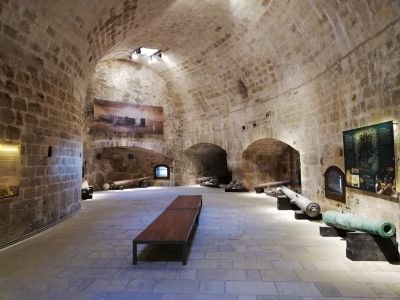
The fort has two storeys and 26 rooms, reached by a staircase whose landing carries a carved slab set in 1539. The walls reach 8.7 m in thickness in places, and there are three entrances. Scaffolding and blue netting on the seaward facade mark repair work against wave damage, so some sections may be closed off.
The fortress rests on an underwater foundation built directly in the sea using engineering methods of that era. This marine construction demonstrates the advanced building knowledge of the Venetian architects.
The community of curious travelers
AroundUs brings together thousands of curated places, local tips, and hidden gems, enriched daily by 92,805 contributors worldwide.