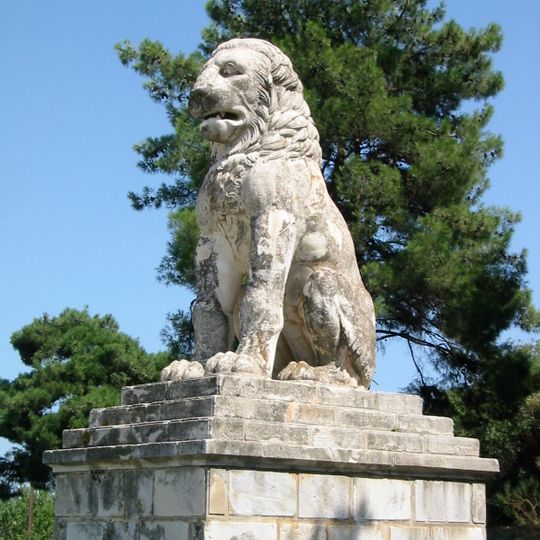
Lion of Amphipolis, Ancient marble monument near Amphipolis, Greece
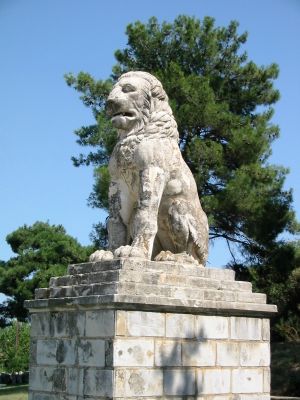
The Lion of Amphipolis is a seated marble lion from the 5th or first half of the 4th century BC, reassembled in 1937 and set about 1 km outside the south gate of ancient Amphipolis. Its body rises over 4 m, the head is 2 m wide, and with the base it exceeds 8 m.
The Lion of Amphipolis is a 4th-century BC tomb sculpture, attributed by Oscar Broneer and Dimitris Lazaridis to Laomedon of Mytilene, a general of Alexander the Great. Its first fragments were found by Greek soldiers in 1912–13 and by British soldiers in 1916; further pieces emerged in the 1930s during drainage works near Lake Kerkini. In 1937, with funding from US ambassador Lincoln MacVeagh and the Greek government, it was restored.
The lion stood as a grave marker, and the Greek sources note that lions served as symbols on tombs; the 2nd-century AD poet Antipatros of Sidon wrote an epitaph for one Teleutias comparing him to a lion. Local online lore claims the lion has no tongue, so it cannot reveal whose tomb it guards.
The site sits in an open, flat area with no covered spaces, so it is wise to bring sun protection during sunny weather. Visitors should wear comfortable shoes, as the surroundings are explored on foot.
Local online lore claims the lion has no tongue, so it could not reveal whose tomb it guarded; another version says the sculptor threw it into the sea after realizing the tongue was missing. In fact, the head is 2 m wide and the body over 4 m tall, and with its base the monument exceeds 8 m.
The community of curious travelers
AroundUs brings together thousands of curated places, local tips, and hidden gems, enriched daily by 93,849 contributors worldwide.