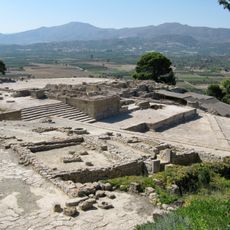
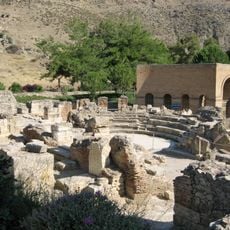
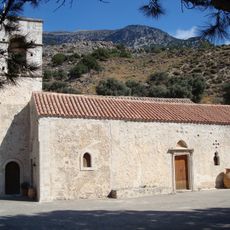
Egyptian Gods sanctuary, Greek sanctuary in Gortyn, Crete, Greece.
The sanctuary of the Egyptian Gods in Gortyn consists of a walled open courtyard measuring 8.50 by 8.20 metres, with two entrances on the west side and a brick floor. A small staircase led up to the oikos behind it, where low benches along the rear wall held three near-life-size cult statues of Isis, Sarapis and Hermanubis. A 2.35-metre limestone architrave with a dedication inscription lies in front of the facade.
The sanctuary arose during the Hellenistic period when Greek communities adopted Egyptian religions and built temples for foreign gods. This era showed how conquest and trade encouraged exchange between cultures.
The sanctuary's name in Greek sources is Naos Egyption Theon. Sarapis was identified with the Cretan-born Zeus and Isis with Kore, linking the Egyptian cult to local worship. Six of the seven inscriptions from the Hellenistic predecessor building were reused in the oikos of the later temple.
The site is easily reached from the town of Gortyn, and visitors should wear comfortable shoes and bring sun protection since the ruins sit on open ground. Early morning or late afternoon visits offer better conditions as the sun is less intense.
The temple was found in 1913 by Italian archaeologists and dug in 1913–1914 under Gaspare Oliverio; Antonino Di Vita re-excavated it in 1997. Six of the seven inscriptions from the Hellenistic predecessor were built into the later oikos. A 2.35 m limestone architrave lying before the facade records the rebuilding by Flavia Philyra and her children, perhaps under Trajan.
The community of curious travelers
AroundUs brings together thousands of curated places, local tips, and hidden gems, enriched daily by 93,012 contributors worldwide.