Monastery Kalivianis, Greek Orthodox monastery in Faistos Municipality, Greece.
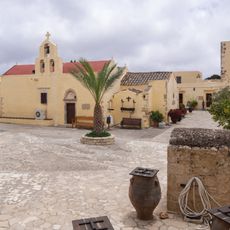
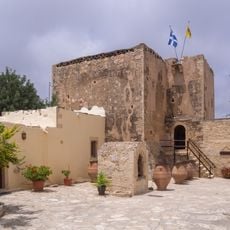
Monastery Kalivianis sits on the island of Crete and displays typical features of a Greek Orthodox monastic complex with stone walls, central courtyards, and religious architectural elements. The buildings are arranged around open courtyards that form the traditional layout of such sacred spaces.
The monastery is relatively recent and does not appear in N. Papadakis's 1881 census of Cretan monasteries. Its land belonged to the Turk Hüseyin Vrazerzade, and in 1873 an old icon of the Annunciation was found under the ruins of a demolished church there. After the Christians' appeal was rebuffed, the governor of Crete Reuf Pasha ordered the land around the village of Kalyvia bought; the small church was rebuilt and named Panagia Kalyviani. Construction of the domed three-aisled Byzantine-style church began in 1911 and was completed in 1924.
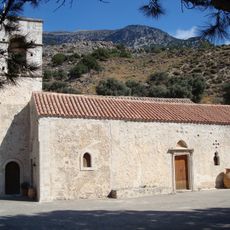
The monastery's name comes from the nearby village of Kalyvia, and its feast is still held on the site where Christians built the church after the land was bought by order of the Ottoman governor of Crete, Reouf Pasha. The small original church survives in the courtyard beside the 1911-1924 domed basilica, which has three aisles dedicated to the Nativity, the Annunciation and the Dormition of the Virgin.
The site is located on Crete and can be reached by local roads, with visiting hours determined by the monastic community. It is advisable to check ahead for open hours and wear respectful clothing that honors the religious nature of the place.
The icon found in 1873 under the ruins of a demolished church, an Annunciation of the Virgin, is kept in the new church built between 1911 and 1924. The small older church still stands in the monastery courtyard, and a festival has been held on the site since the icon's discovery.
The community of curious travelers
AroundUs brings together thousands of curated places, local tips, and hidden gems, enriched daily by 93,276 contributors worldwide.