Kommos, Archaeological site in Faistos Municipality, Greece.
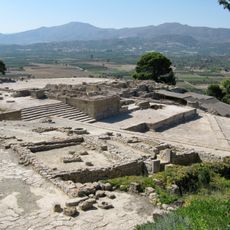
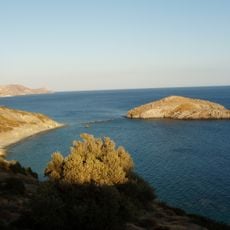
Kommos is an archaeological site along the southern coast of Crete featuring extensive ruins of ancient buildings, storage warehouses, and religious structures directly by the sea. The remains reveal the layout of a former harbor settlement with storage facilities and shipyards from Minoan times.
Kommos was settled from about 1900 BC as the harbour of Phaistos and later Hagia Triada, after silting cut those centres off from the sea. It served as a Minoan port until around 1200 BC and as a Greek settlement into Roman times, being abandoned around AD 200. Arthur Evans first heard of the site in 1924 from storage jars found there and speculated about a Bronze Age customs house; official excavations, led by Joseph and Maria Shaw of the University of Toronto, only began in 1976.
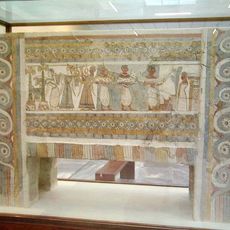
Pottery found here reveals trading connections with Central Greece, the Cyclades, Cyprus, the eastern Mediterranean, and Egypt in ancient times. These artifacts show that the place was a major hub for exchanging goods between different regions around the sea.
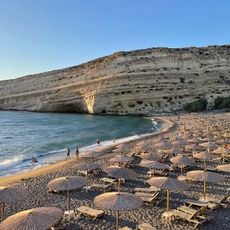
Access to the archaeological site is limited, but visitors can view the ancient structures from the nearby beach area. The location right by the water makes it easy to stop by from the beach and see the historical remains.
The largest ashlars the Minoans ever used form the facade of Building T, the palatial structure built in MMIII on the site's southern edge. These tall, narrow slabs set on edge are called orthostats. Building T was later replaced by the court-centred Building N and Building P, whose six open galleries facing the sea are read as ship sheds.
The community of curious travelers
AroundUs brings together thousands of curated places, local tips, and hidden gems, enriched daily by 94,360 contributors worldwide.