Hagia Triada, Archaeological site in Messara Valley, Greece
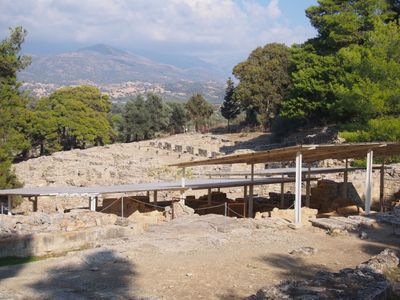
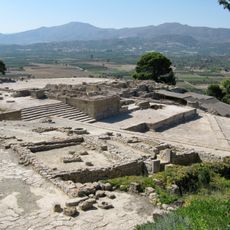
Hagia Triada is a Minoan archaeological site on a hillside in the western Mesara Plain, about three kilometres from Phaistos. Its excavated remains are divided into a Villa, a small palace-like administrative building, and a Village area, with three large storage magazines. Low walls of rough pale grey blocks trace rectangular rooms and floor sections across uneven ground, some stepped down the slope, with upright slabs among the rubble and long flat protective roofs on thin metal posts above parts of the walls.
The site was founded in the Early Minoan I period and grew rapidly from the Middle Minoan IB to IIB, with an extensive building program starting around 1925 BC. A fire destroyed it toward the end of Late Minoan IB (c. 1625–1470 BC), after which it was monumentally rebuilt and came under Mycenaean control. It was destroyed and abandoned in the 13th century BC, later used as a sanctuary in the Protogeometric period and again in Hellenistic times, and finally hosted a Roman villa after 69 BC.
The artifacts here reveal artwork and crafts connected to the eastern Mediterranean world. The decorative patterns and materials suggest people living here traded with distant regions.
The site is located near Phaistos Palace and is usually open to visitors during daylight hours. It is wise to wear comfortable shoes and protect yourself from the sun, as the hillside area offers little shade.
Two Early Minoan tholos tombs lie east of the fenced excavation area. The larger, 9 m across with walls 1.8–2.0 m thick and an entrance on the east, held about 150 burials with grave goods from the Prepalatial and Protopalatial periods; the half-ruined second tomb was reused in the Postpalatial period.
The community of curious travelers
AroundUs brings together thousands of curated places, local tips, and hidden gems, enriched daily by 92,856 contributors worldwide.