Phaistos, Archaeological site in Faistos, Crete, Greece
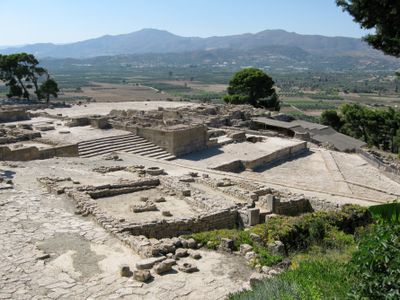
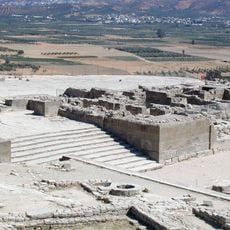
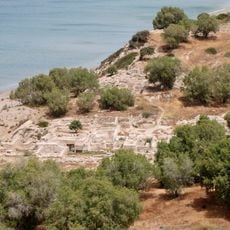
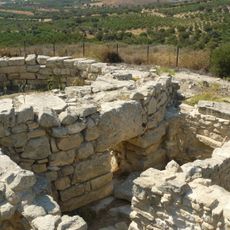
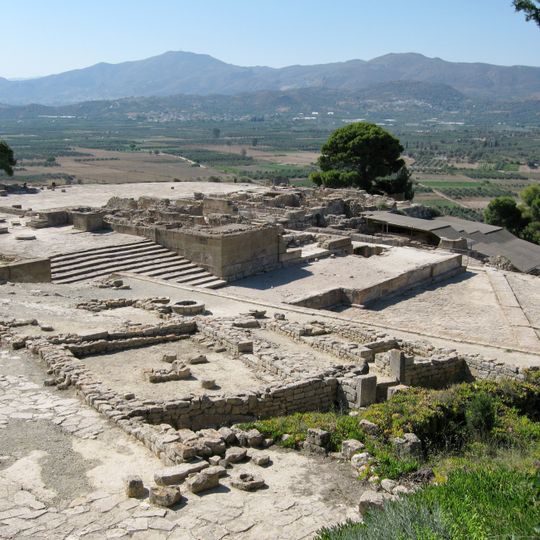
Phaistos is a Minoan palace complex on a hilltop above the Messara plain, covering 8,400 m², second in size only to Knossos. Its rooms were built on several vertical levels linked by halls and staircases, with floors and walls faced in white gypsum. The visible remains include a broad stepped staircase leading to a raised platform, a central courtyard, and a row of upright stone slabs.
The first palace was built between 1900 and 1850 BCE, when Phaistos rivaled Knossos. It was damaged by earthquakes and a fire, and destroyed around 1700 BCE; rebuilding began around 1600 BCE but was never completed. A fire around 1450 BCE ended the palace, though the settlement continued into Geometric and Classical times.
Phaistos was named after a son or grandson of Herakles, and Rhadamanthys, brother of Minos, was said to be its first ruler. A temple to Rhea stood south of the central court, linked to a ritual called ekdysia. The city struck its own coin, the stater, and its people were known for humorous adages.
The site sits on a steep hillside, so bring sturdy shoes and plenty of water for your visit. Early morning or late afternoon visits work best, as the heat can be intense and crowds tend to be smaller during these times.
A mysteriously inscribed clay disc found here displays symbols arranged in a spiral pattern and dates to around 1500 BCE. Its meaning remains unsolved to this day, making it one of archaeology's greatest puzzles.
The community of curious travelers
AroundUs brings together thousands of curated places, local tips, and hidden gems, enriched daily by 92,980 contributors worldwide.