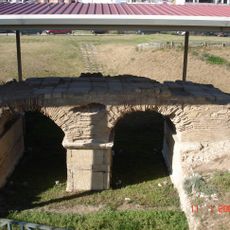
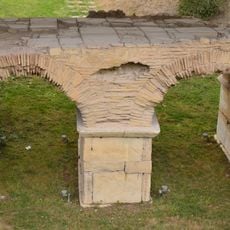
Mycenaean cemetery of Voudeni, Mycenaean necropolis in Skioessa, Greece.
The Mycenaean cemetery of Voudeni lies at the Amygdalia spot west of today's village, southeast of the prehistoric settlement on the Bortzi hill. Its 78 chamber tombs, cut into soft ground over 18 acres, vary in plan: circular, square, horseshoe or four-sided, each roofed with a dome and often holding several burials. Tombs 4 and 75 are the largest, taken to be the graves of officials or lords.
Excavations began in 1923 under Nikolaos Kyparissis and uncovered remains dating from approximately 1500 to 1050 BC. The recovered objects such as bronze tools, weapons, jewelry, and pottery reveal the wealth and technical skills of this society.
The cemetery lies at the Amygdalia spot west of today's Voudeni village, on soft ground that made carving easy. Most tombs are chamber graves cut into the hillside, circular, square, horseshoe-shaped or four-sided, often with a dome and several burials inside. Tomb 4 and Tomb 75, the largest, are thought to have belonged to officials or local lords.
The park covers 180 acres at an altitude of 220 metres, about 7 km northeast of Patras near the village of Voudeni. The tombs lie on the Amygdalia hillside west of the village, southeast of the settlement ruins at Bortzi. School groups take part in excavation workshops led by archaeologists, so the grounds can be busy on weekday mornings.
The position at the base of Mount Panachaiko provided residents with natural defenses and enabled control over trade routes in the Gulf of Patras. This geographic location made the area a preferred settlement for this early civilization.
The community of curious travelers
AroundUs brings together thousands of curated places, local tips, and hidden gems, enriched daily by 92,913 contributors worldwide.