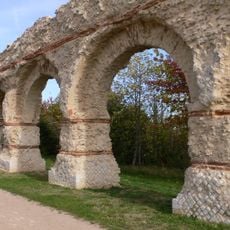
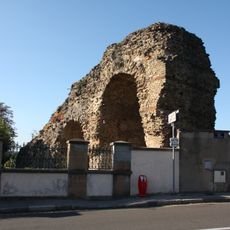
Aqueduc de l'Yzeron, Roman aqueduct in Craponne, France.
The Yzeron aqueduct is a Roman water system with multiple collection branches that meet at specific locations in Grézieu-la-Varenne and Craponne. The structure spans a considerable distance and still displays visible pillars and water channels throughout its course.
Construction started in ancient times to supply water to the city of Lugdunum, now known as Lyon. This project represented part of Rome's effort to build major infrastructure across the region using advanced water engineering methods.
The name "aqueduct of Craponne" comes from Camille Germain de Montauzan, after the town where the branches meet. The Tourillon piles at Craponne are what remain of the intermediate reservoir between the two siphons. The aqueduct's name refers to the Yzeron, a tributary of the Rhône whose catchment supplied the water.
Visitors can follow a walking trail along the aqueduct's path to see different preserved sections of the structure. The best time to explore is during dry weather, as some areas have uneven ground and require careful footing.
The Tourillon piles at Craponne are the surviving supports of the intermediate reservoir between the aqueduct's two successive siphons. The Yzeron branch drew water at 710–715 m, a steep drop that risked scouring the channel, so this aqueduct became the testing ground for drop shafts (chutes brise-pente) to slow the flow.
The community of curious travelers
AroundUs brings together thousands of curated places, local tips, and hidden gems, enriched daily by 94,542 contributors worldwide.