Notre-Dame d'Amiens, Gothic cathedral in Amiens, France
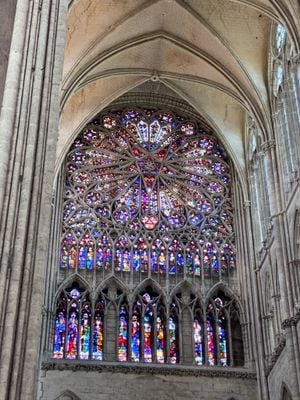
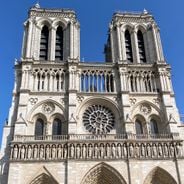
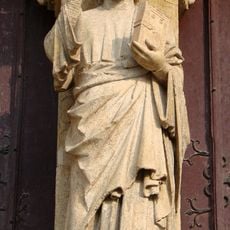
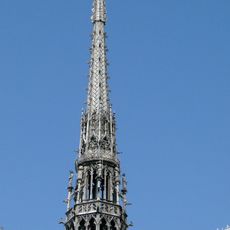
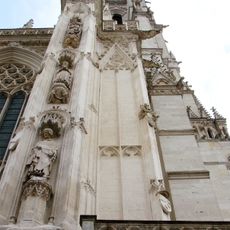
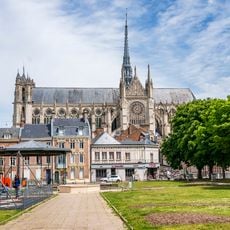
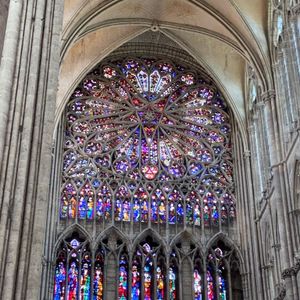
Notre-Dame d'Amiens is a Catholic cathedral on a slight ridge above the River Somme in Amiens, northern France. Its west facade has two square towers, three recessed pointed portals with carved archivolts and statues, a row of niches holding standing figures, and a large rose window under a pointed arch. Built mostly between 1220 and 1270, it is the largest cathedral in France by interior volume, 200,000 cubic metres.
Construction began in 1220 after a fire destroyed the earlier church, and was led by Robert de Luzarches. The work continued for several decades and was largely completed in the late 13th century.
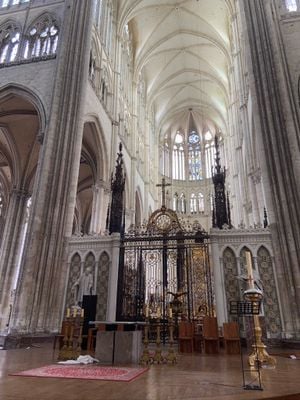
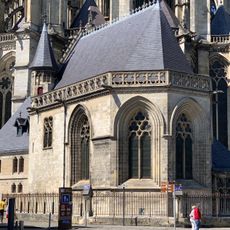
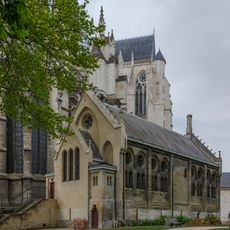
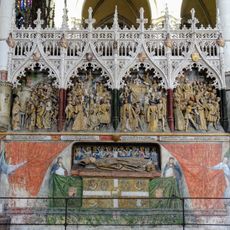
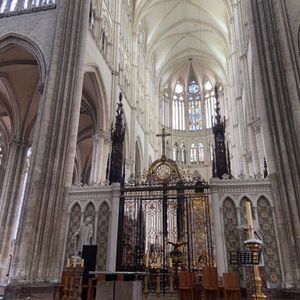
The cathedral is dedicated to the Virgin Mary, and the axial chapel of the Virgin was originally called "Notre-Dame la Drapière" because the drapers' guild funded it from the woad trade. The choir enclosure carries high reliefs of the lives of Saint Firmin and Saint John the Baptist, and a window of 1269 shows Bishop Bernard d'Abbeville presenting a stained-glass panel to the Virgin.
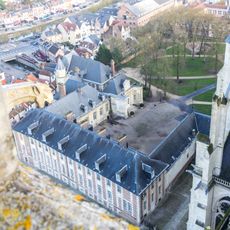
The three portals of the west facade open onto the Place Notre-Dame; the towers are managed separately by the Centre des Monuments Nationaux. The cathedral lies on a slight ridge above the River Somme, a short walk from the city centre and its station. Look for the wrought-iron chain installed red hot by Pierre Tarisel in 1498 around the transept crossing columns.
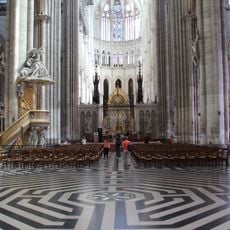
The labyrinth set into the nave floor is a copy of a 1288 design; its centre stone once carried a brass plaque naming the four master builders, Robert de Luzarches, Thomas and Renaud de Cormont, and the year 1288. The original was melted down in 1825.
The community of curious travelers
AroundUs brings together thousands of curated places, local tips, and hidden gems, enriched daily by 92,748 contributors worldwide.