Orgue de tribune de la cathédrale Notre-Dame d'Amiens, Pipe organ at Notre-Dame Cathedral, Amiens, France.
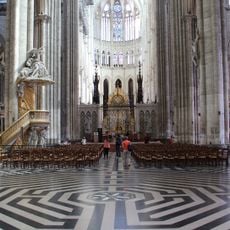
The organ at Notre-Dame Cathedral in Amiens is a large pipe instrument mounted on the western wall of the nave, positioned about 17 meters (56 feet) above the floor beneath the rose window. The instrument contains 42 stops divided among several sections including the Positif de dos, Grand-Orgue, Récit expressif, and Pédale divisions.
The original instrument was constructed between 1429 and 1431, funded by Alphonse Lemire, a valet of King Charles VI, and his wife Massine de Hainaut. The work later underwent significant rebuilding by renowned organ builders including John Abbey in 1832 and Aristide Cavaillé-Coll between 1884 and 1889.
The organ carries French names for its divisions such as Grand-Orgue and Récit expressif, which reflect the craftsmanship tradition of organ building in the country. Visitors walking through the cathedral can appreciate how these naming conventions shaped the character of this regional musical heritage.
The instrument sits high on the western wall and is visible from many vantage points throughout the cathedral. Visitors interested in studying the organ should position themselves where they can see the pipes and their arrangement clearly.
During World War I, Paris firefighters dismantled the organ and stored it for protection. It remained in storage until its reassembly between 1935 and 1937.
The community of curious travelers
AroundUs brings together thousands of curated places, local tips, and hidden gems, enriched daily by 91,369 contributors worldwide.