Église Saint-Pothin, Neoclassical Catholic church in 6th arrondissement, Lyon, France.
Église Saint-Pothin is a Neoclassical church whose facade carries a hexastyle Doric portico with a triangular pediment and a cross above it. The Latin-cross plan ends in a choir under a cul-de-four, with the bell tower and sacristies beyond it. Inside, a blind central nave with a barrel vault is flanked by two aisles on Ionic colonnades, and a dome crowns the transept crossing.
Construction took place between 1841 and 1843 under architect Christophe Crépet, during a period of urban expansion in Lyon. The church was part of the development of the Brotteaux district, reflecting the city's growth during this era.
The parish takes its name from Saint Pothinus, the first bishop of Lyon, martyred with Blandina and others in 177. In the side aisles, Émile Bégule's 1932 windows, made by the Balmet workshop in Grenoble, set the founders of the Church of Lyon (Irenaeus, Polycarp, Blandina, Pothinus) on the north side and the French saints Geneviève and Clotilde on the south. A 1656 painting of Saint Paul before the Areopagus, once kept at Notre-Dame de Paris, hangs inside.
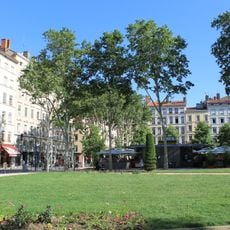
The building is located at Place Edgar Quinet in the 6th arrondissement and welcomes visitors during opening hours, particularly outside of religious services. Plan your visit accordingly, as access may be restricted during worship times.
The church's first organ was built in 1846 by Daublaine-Callinet; Joseph Merklin supplied a new two-manual instrument in 1876, enlarged in 1880 and 1910, and rebuilt by Kern in 2004. From 1945 organist Adrien Rougier invited Marcel Dupré, Pierre Cochereau, Maurice Duruflé and Marie-Claire Alain to play here, and Duruflé gave the organ version of his Requiem in this church.
The community of curious travelers
AroundUs brings together thousands of curated places, local tips, and hidden gems, enriched daily by 94,099 contributors worldwide.