Catacombs of Paris, France, Underground ossuary in Paris, France
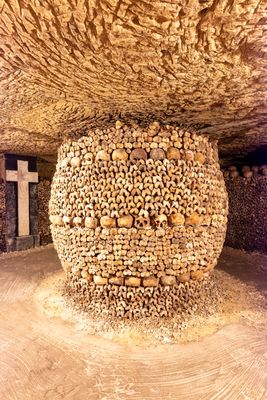
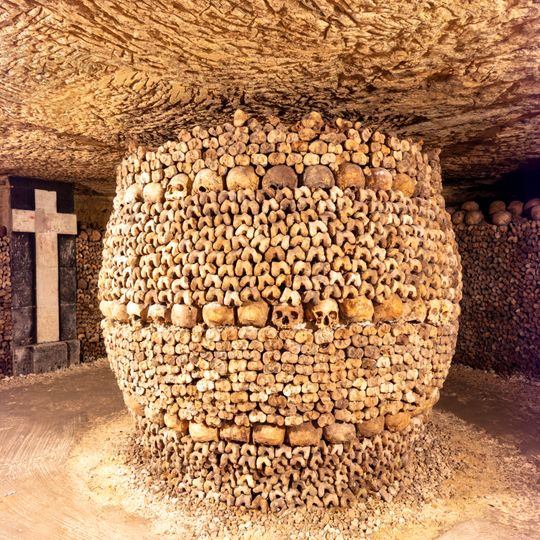
The Catacombs of Paris are an underground ossuary in the fourteenth arrondissement of Paris, France. They consist of a network of tunnels and chambers lined with human bones, including a famous barrel-shaped column of skulls and femurs, and a wall of tightly packed bones with skulls arranged in patterns.
The ossuary was created in the late eighteenth century to solve public health problems caused by overcrowded cemeteries. Bones were transferred from Paris cemeteries between 1786 and 1860, and the site opened to the public in 1809.
The name "Catacombs" was borrowed from the Roman catacombs, which had fascinated the public since their discovery. Inspector Héricart de Thury added plaques with religious and poetic texts along the galleries, and named areas after religious, Romantic or Antique sources, such as the Lacrymatory Sarcophagus, the Samaritan Fountain and the Sepulchral Lamp.
The visit covers about 1.5 km and begins with 131 steps down to a depth of 20 metres; the route ends at 21 bis, avenue René-Coty, not at the entrance on Place Denfert-Rochereau. The site is closed on Mondays and the last entries are at 19:30. Access is by metro lines 4 and 6 or RER B at Denfert-Rochereau.
The bone wall's façade alternates rows of femurs and tibiae with skulls, a layout set by Inspector Héricart de Thury before the 1809 opening. In 1813 he placed four goldfish in the Samaritan Fountain basin; they survived but never reproduced and went blind. In 1861 Nadar made the first photographs by artificial light here, using dummies for the long exposures.
The community of curious travelers
AroundUs brings together thousands of curated places, local tips, and hidden gems, enriched daily by 92,080 contributors worldwide.