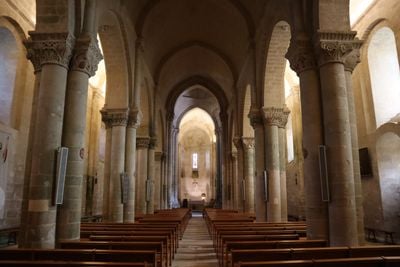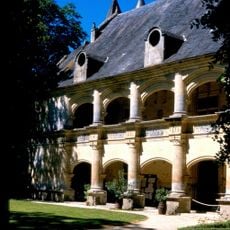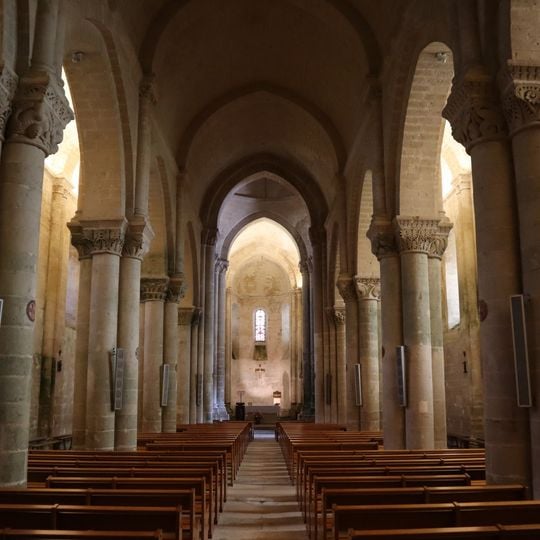
Church of Saint-Pierre d'Aulnay, Romanesque church in Aulnay, France.
The Church of Saint-Pierre d'Aulnay is a Romanesque church built in the 1120s–1140s for the canons of Poitiers. Its interior has a high rounded stone vault, tall round arches on thick columns with carved leaf capitals, and rows of wooden benches along a stone-paved aisle. The west facade carries carved figures, including elephants and the first arc of the gate inspired by Oriental designs.
Built between 1120 and 1140 by canons from Poitiers, the church was constructed on the foundations of a former Celtic temple and Gallo-Roman sanctuary. This layering reveals how successive cultures reused the same sacred location.
The church's carved capitals show elephants and other motifs drawn from Oriental models, while the first arch of the west portal follows an Oriental design. These carvings sit alongside Romanesque sculpture rooted in Poitou and Saintonge. Mouldings from the church are displayed at the Cité de l'Architecture et du Patrimoine in Paris.
The church stands within a walled enclosure that was formerly a cemetery, entered before reaching the building; walking its perimeter lets you view the architecture and sculpture from several levels. The south portal served as the only entrance from the Reformation until restoration began in 1756, so approach from that side. The enclosure lies at the crossing of the old Melle–Cognac and Melle–Saintes roads.
The church sits at the intersection of two pilgrimage routes leading to Santiago de Compostela, bringing travelers from different directions together. Plaster casts of its stonework decorations are displayed at the Architecture and Heritage Museum in Paris.
The community of curious travelers
AroundUs brings together thousands of curated places, local tips, and hidden gems, enriched daily by 92,863 contributors worldwide.