Château de Dampierre-sur-Boutonne, Renaissance castle in Dampierre-sur-Boutonne, France.
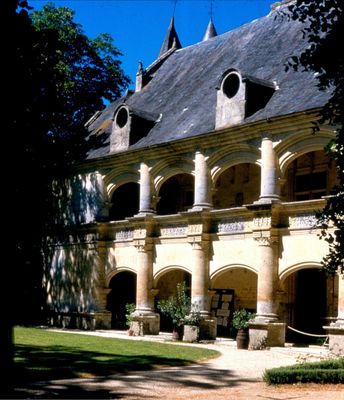
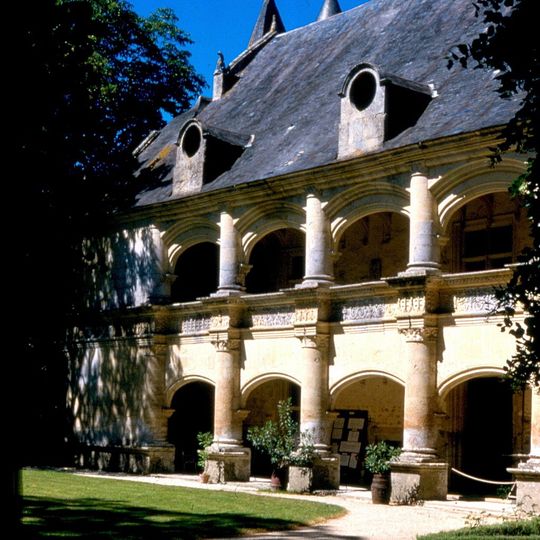
Château de Dampierre-sur-Boutonne stands on an island of the Boutonne, built at the end of the 15th century and given two superimposed Italianate galleries around 1550. The pale stone facade rises in two arcaded levels of four round-headed arches on cylindrical columns, beneath a steep slate roof with dormer windows. A carved coffered vault with emblematic and alchemical decoration covers the gallery.
Construction began in 1495 under François de Clermont following his return from the Italian wars. The castle was completed soon after, reflecting Italian Renaissance influences on French architecture.
The two superimposed Italian-style galleries added between 1545 and 1550 by Jeanne de Vivonne, sister of La Châtaigneraye, are the castle's centrepiece. Their coffered vault carries an emblematic and alchemical decoration built on the cipher of Henri II, read as H + C or H + D. A cousin of the Clermonts, Antoine III de Clermont, had married Diane de Poitiers' sister.
The castle stands on an island of the Boutonne, with the outbuildings, moats, enclosure walls and bridges around it; the two islands were listed as monuments in 1990. The site stayed open to visitors even after the 2002 fire that destroyed the roof frame and covering. Visits run all year, and from spring to autumn the friends of the castle association organises concerts and exhibitions.
The two superimposed Italian-style galleries added around 1550 have a coffered vault whose emblematic and alchemical decoration carries the cipher of Henri II, readable as H + C or H + D. A cousin of the Clermonts of Dampierre, Antoine III de Clermont, had married Diane de Poitiers's sister.
The community of curious travelers
AroundUs brings together thousands of curated places, local tips, and hidden gems, enriched daily by 93,930 contributors worldwide.