Crisbecq Battery, World War II military museum in Saint-Marcouf, France
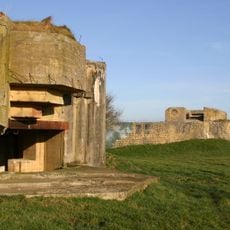
Crisbecq Battery is a World War II military museum housed within a fortified coastal position featuring multiple concrete bunkers, gun emplacements, and underground tunnels spread across an expansive fortified area. The site displays the layout and construction methods typical of defensive positions built along the French coast.
Construction of the Crisbecq battery began in 1941 under the Todt Organization, using Russian and Polish prisoners of war and, from 1943, hired French workers. On 6 June 1944 its commander, Oberleutnant zur See Walter Ohmsen, sighted the Allied fleet and opened fire at 5:52 a.m., the first battery of the landings to do so; it sank the destroyer USS Corry. The Germans evacuated the site on 11 June 1944.
The exhibits feature personal belongings of soldiers and photographs showing everyday life during the German occupation. These objects help visitors understand what daily routines were like for the people stationed at this location.
The battery stands on a ridge above the hamlet of Crisbecq, about 2 km from the sea, with a view from Saint-Vaast-la-Hougue to Grandcamp. The ground is uneven and partly overgrown, and the concrete casemates and shelters are entered through dark, narrow openings. Sturdy shoes and a torch are useful; the site is not fully finished even today, as construction stopped in June 1944.
Only two of the planned four Regelbau R683 casemates were finished by June 1944; the third was still under construction with its gun barely protected, and the fourth was never built. Each finished casemate measured 21 by 16 metres and 8 metres high, using 2,000 cubic metres of concrete and 100 tonnes of steel, with a 120° firing arc.
The community of curious travelers
AroundUs brings together thousands of curated places, local tips, and hidden gems, enriched daily by 93,390 contributors worldwide.