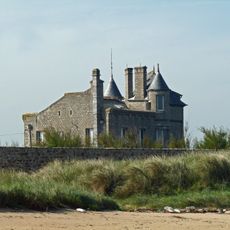
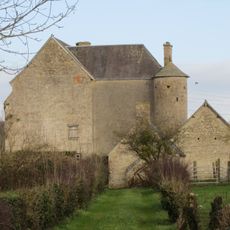
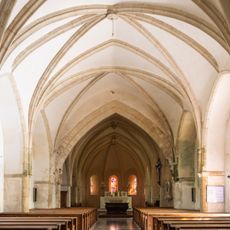
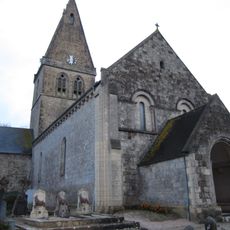
Batterie d'Azeville, German artillery battery in Azeville, France.
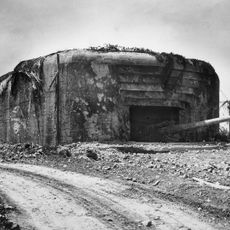
Batterie d'Azeville is a coastal artillery installation in Normandy featuring four reinforced concrete casemates connected by an extensive network of underground passages and covered trenches. This underground system formed the operational core of the defensive position.
Construction began in 1941, and by December four French 105 mm guns from World War I stood in open pits. In 1943 Organisation Todt added four casemates, two H671 and two H650, using forced labour. The garrison of 170 men fired on Utah Beach until 9 June 1944, when flamethrowers forced its surrender.
The battery's outer walls were painted to resemble local ruined buildings, a camouflage measure still faintly visible on the concrete. The site is owned by the local council, and one casemate houses a museum. The garrison of 170 officers and men had no barracks on site and was billeted in surrounding villages, so soldiers lived among local families.
The site is accessed by foot from the nearby village, and most areas are walkable on ground level paths. Visitors should wear sturdy shoes since the underground sections have damp and uneven surfaces.
The outer walls of the casemates were painted to resemble local ruined buildings, a camouflage measure meant to hide the battery from Allied air observation. Look for traces of this paintwork on the concrete faces. The site is owned by the local council, and one casemate now holds a museum.
The community of curious travelers
AroundUs brings together thousands of curated places, local tips, and hidden gems, enriched daily by 93,603 contributors worldwide.