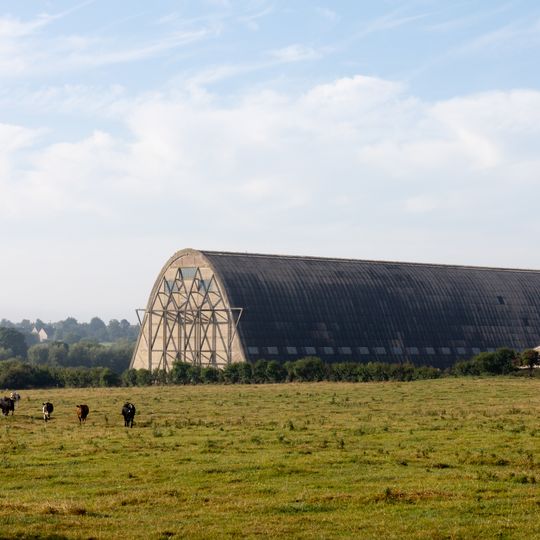
Écausseville airship hangar, Military airship hangar in Écausseville, France.
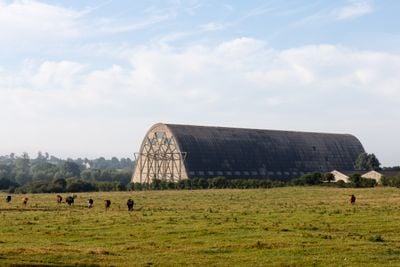
The Écausseville airship hangar is a 150-metre-long concrete hangar, 24 metres wide and 28 metres high, built from 1917 to 1919 on Henry Lossier's plans using François Hennebique's reinforced-concrete process. Its roof rests on 25 reinforced-concrete trusses and 2,540 concrete tiles made on site, under a vault shaped as an inverted chain with a 12-metre radius. The photograph shows the barrel roof and the beige end wall with its crisscrossing wooden framework.
The French Navy built this hangar in 1917 to house airships that patrolled the Channel coast during World War I. After the war ended, it was repurposed by different military forces and later converted for entirely different uses.
The hangar's name comes from the hamlet of La Bazirerie in Écausseville, chosen because the site is sheltered from the dominant westerly winds and allows takeoff with ascending air currents. Since 2008 the hangar has belonged to the Cotentin agglomeration community, while the Association des amis du hangar à dirigeables d'Écausseville keeps the mediation role. In summer, visitors can fly inside the hall in an aéroplume, a small human-powered airship.
The hangar is located in a rural area and is best reached by car, as it sits outside any town center. Plan time to explore all sections, as the space is quite large to walk through.
Between 1967 and 1969 the hangar hosted pre-tests for the design of France's first atomic bomb, during a pause in its use for storing Cherbourg naval equipment. The building had already housed airships only once, in 1922.
The community of curious travelers
AroundUs brings together thousands of curated places, local tips, and hidden gems, enriched daily by 93,544 contributors worldwide.