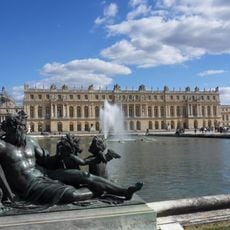
Grande Commande, Marble sculpture collection in Palace of Versailles Gardens, France
The Grande Commande is a set of 24 marble statues and four sculpted groups ordered in 1674 for the Parterre d'Eau at Versailles, designed by Charles Le Brun after Cesare Ripa's Iconologia. The 24 statues personify the four elements, the four parts of the world, the four seasons, the four times of day, the four temperaments and the four poetic genres; the four groups show the abductions of Persephone, Cybele, Oreithyia and Coronis. Transferred elsewhere in the gardens in 1684, they stand today on plain rectangular pedestals, several replaced by copies.
The project began in the 1670s under the direction of Charles Le Brun, who oversaw more than twenty sculptors. The sculptures were moved several times later as garden design changed over the following decades.
The sculptures portray goddesses, seasons, and muses that suggest music and the arts in the garden. They show how Baroque art expressed connections between humans, nature, and the divine through allegorical forms.
The sculptures are located in the open garden area, so they are weather-dependent and may occasionally be hidden for restoration work. Visitors should wear sturdy shoes since the terrain is uneven and exploring requires long walks through the grounds.
The term Grande Commande was not coined until the 1930s, describing one of the most ambitious artistic projects of the 17th century. Although the sculptures had existed for nearly four centuries, they were only given this unifying name long after their creation.
The community of curious travelers
AroundUs brings together thousands of curated places, local tips, and hidden gems, enriched daily by 94,322 contributors worldwide.