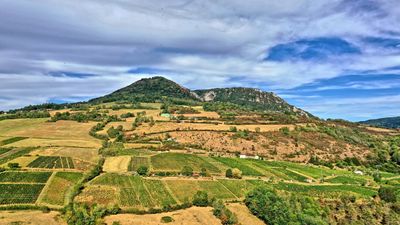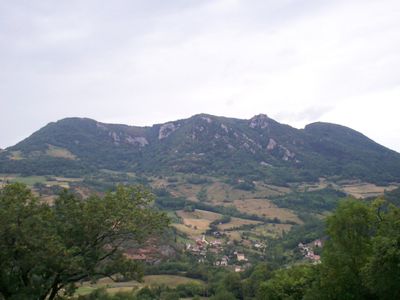
Mont Poupet, Mountain and free flight site in Jura, France.
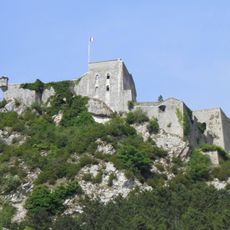
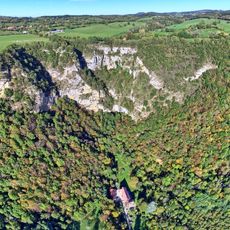
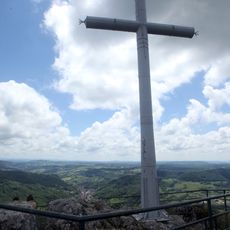
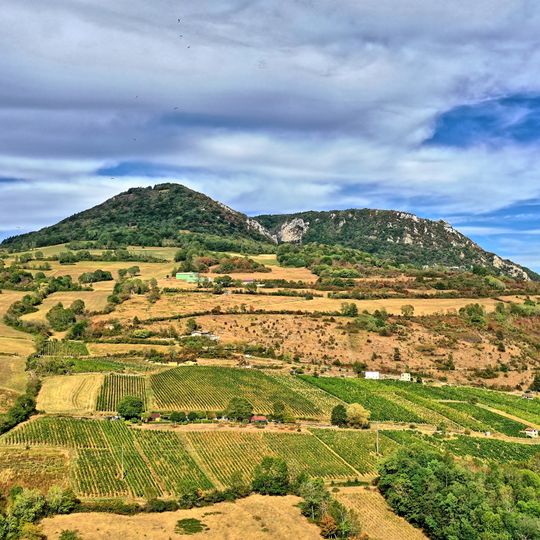
Mont Poupet is a limestone mountain in the Jura department, rising to 851 metres. Its summit, at a spot called le Signal in Saint-Thiébaud, has a cross and an orientation table on the south face. The upper slopes are Middle Jurassic limestone, while the base is Lias marls and Triassic variegated marls.
The summit held the castle of the sires de Poupet, a family of the county of Burgundy whose members served as chamberlains and ambassadors to Charles V; Guillaume de Poupet (1506-1583) was abbot of Baume-les-Messieurs. On 3 October 1860 Louis Pasteur climbed to the 851 m summit and opened twenty flasks of yeast sealed under vacuum to air, of which only five fermented, supporting his refutation of spontaneous generation.
The mountain's name comes from the Poupet family, lords of a castle once standing on the site; Guillaume de Poupet (1506–1583) was master of requests at the Dole parliament. A rare protected flower, the mountain vulnerary, is locally called "pompon du Poupet" and was once brewed into "thé du Poupet". Since 1985 Salins-les-Bains hosts the annual Montée du Poupet foot race, which draws nearly a thousand runners.
Several marked trails lead to the launch areas with parking available at the base of the mountain. Check local weather conditions before visiting, as wind and thermal activity affect flying feasibility.
On 3 October 1860 Louis Pasteur climbed to the summit, 851 m, to test spontaneous generation: he opened twenty vacuum flasks of yeast to the air, and only five fermented. He had run the same experiment at Arbois, 250 m, beforehand. The result helped refute the theory that microbes arise on their own.
The community of curious travelers
AroundUs brings together thousands of curated places, local tips, and hidden gems, enriched daily by 95,283 contributors worldwide.