Mont Puget, Mountain summit in Calanques National Park, Marseille, France
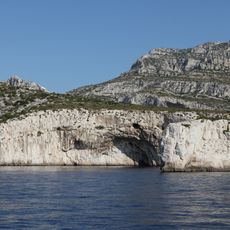
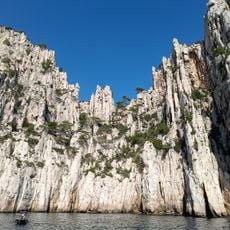
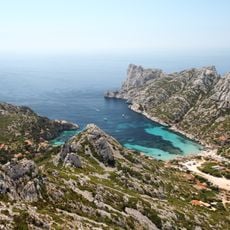
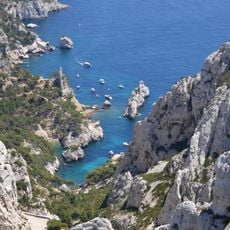
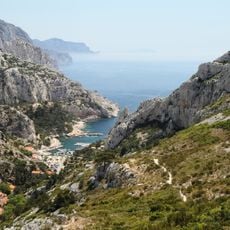
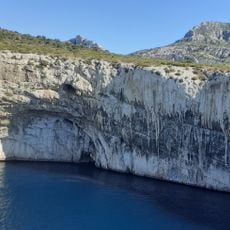
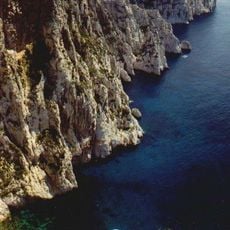
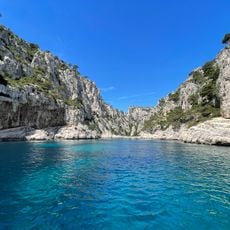
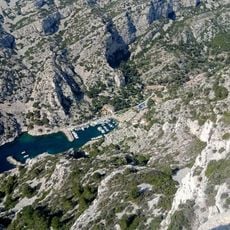
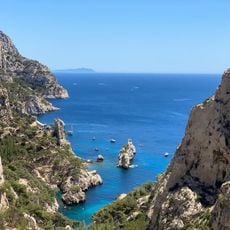
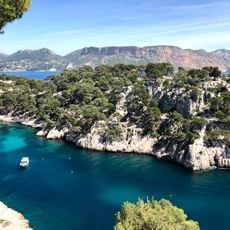
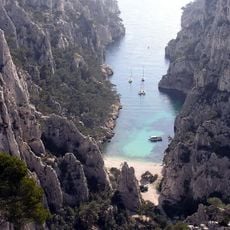
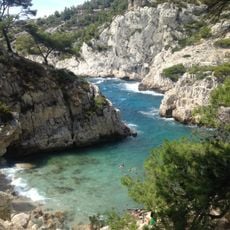
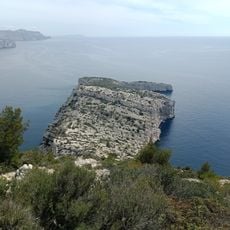
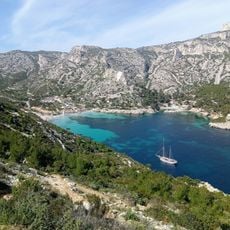
Mont Puget is the highest point of the Calanques massif, rising to 563 metres in the Bouches-du-Rhône department south-east of Marseille. It consists of white Urgonian Cretaceous limestone, with a bare, cracked rock face forming vertical cliffs and stepped ledges above slopes covered in dense low green scrub and scattered pale stones. The summit line is uneven, with a higher mass on the right and a lower section on the left.
The name comes from the Provençal word 'puech', meaning elevated place, which derives from the Latin 'podium' referring to geographical height. The mountain's limestone structure formed through geological processes spanning millions of years that shaped the rocky ridges of this region.
The name Puget comes from the Provençal "puech", a diminutive of the Latin "podium" meaning an elevated place, making "Mont Puget" a pleonastic toponym. A popular belief links it to the Marseille sculptor Pierre Puget, but the name appears on maps well before him. The summit looks over both the north and south harbours of Marseille.
Three marked routes reach the summit: from the col de la Gineste and col Ricard on a red-marked path, from Luminy via the col de Sugiton and GR 51-98 to the col de la Candelle then a green-marked path, or via the sentier du Centaure and the couloir de l'aiguille Guillermin. The trail doubles as an access track for firefighters during wildfires, so keep it clear. The top is bare eroded limestone with needle-like spikes; wear sturdy shoes and carry water.
The summit's limestone is eroded into numerous needle-like spikes, a detail visible along the top ridge. The Luminy Faculty of Sciences, 1 km northwest, carries a stylized representation of Mont Puget on its crest. The mountain's name long predates the sculptor Pierre Puget, appearing on maps millennia before him.
The community of curious travelers
AroundUs brings together thousands of curated places, local tips, and hidden gems, enriched daily by 94,155 contributors worldwide.