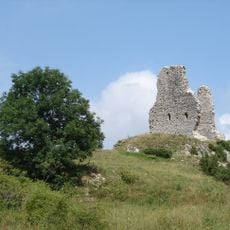
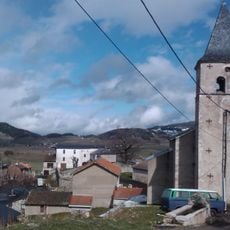
Burg Niort-de-Sault, Medieval castle ruins in Niort-de-Sault, France.
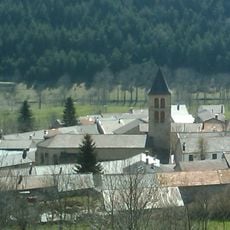
Burg Niort-de-Sault is a ruined hilltop castle on a two-needled rock outcrop above the village, the Rébenty valley and the road from Belcaire to Mazuby. Almost entirely overgrown, it keeps collapsed stone walls, a gun port, a rock-cut staircase of about a dozen steps, a basin-like hollow and, in the floor of what was probably the keep, a cross carved into the rock.
A Visigothic fortress stood here from the 6th century; in 845 it was granted to Argila, count of Razès, and passed to his son Bera, who took the title baron of Niort. In 1240 Géraud de Niort handed his castles to Louis IX, who confiscated them; after a siege in summer 1255 the family capitulated. The castle was kept for its strategic position on the Aragonese border, then burned by Calvinist troops under Jean de Lévis in 1573.
The name Aniort, used in medieval texts, comes from the Latin anus orta, "old exit", which gave rise to a legend: the besieged escaped in 1255 through a passage cut into the rock. In the cellar of the former keep, a worn engraving is interpreted as a Cathar cross.
The castle remains are reachable via marked paths, though the remote location requires proper planning and sturdy walking shoes. Visit during dry weather to avoid slippery terrain and to get the most from exploring the site.
Local stories speak of a hidden passage within the castle walls that allowed defenders to escape during attacks. This secret route reveals how carefully fortified places were designed to give their occupants a chance to flee.
The community of curious travelers
AroundUs brings together thousands of curated places, local tips, and hidden gems, enriched daily by 93,686 contributors worldwide.