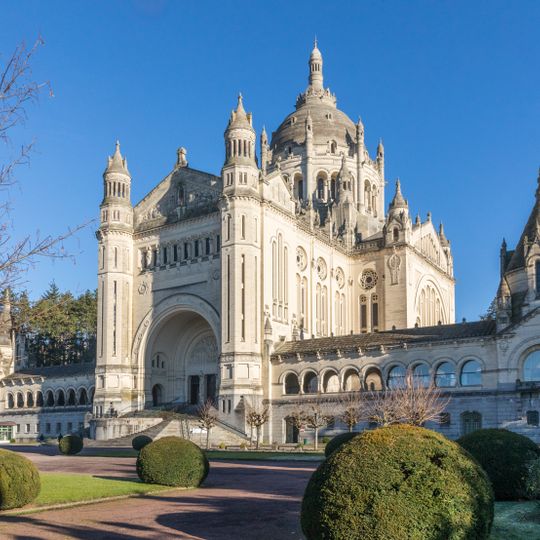
Basilica of Sainte-Thérèse, Lisieux, Religious basilica in Lisieux, France
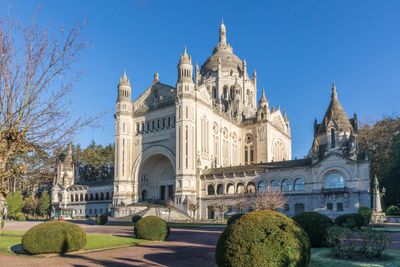
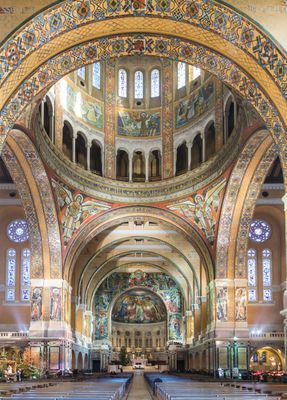
The Basilica of Sainte-Thérèse is a neo-Byzantine church on a hill at the southeastern edge of Lisieux, built of reinforced concrete faced with Bleu de Vire granite. It is shaped as a Latin cross, 104 m long with a 45 m transept, and a 97 m dome with a lantern rises over the crossing. The west portal is inscribed "SANCTA THERESIA A JESU INFANTE"; inside, mosaics cover the vaults, with angels flanking the central arch and the words "MONTREZ QUE VOUS ETES NOTRE MERE" along a band.
Construction began in 1929 under architect Louis Marie Cordonnier's leadership and continued through the 1940s. The basilica was consecrated in 1954 after surviving the war period.
The basilica's 18 minor altars were each donated by a different nation devoted to Saint Thérèse, and the mosaics carry French inscriptions such as "MONTREZ QUE VOUS ETES NOTRE MERE" above the central arch. The Carmelites of Lisieux, including two of Thérèse's sisters, sheltered in the crypt during the summer of 1944.
The basilica stands on a hill at the southeastern edge of Lisieux, with a 76-metre-wide esplanade before the main stair. The separate bell tower rises on the square and gives carillon concerts twice a day. The crypt, inaugurated in 1932, is reached from inside and holds marble and mosaic scenes of Thérèse's life; a worship chapel added in 2000 opens through it.
The detached bell tower on the square was built in the 1960s and never fully finished, charity taking priority over completion. Its 51 bells, given by Belgium and the Netherlands, play carillon concerts twice a day.
The community of curious travelers
AroundUs brings together thousands of curated places, local tips, and hidden gems, enriched daily by 94,350 contributors worldwide.