Rochefort-Martrou Transporter Bridge, Transporter bridge in Rochefort, France
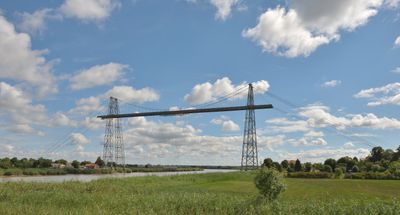
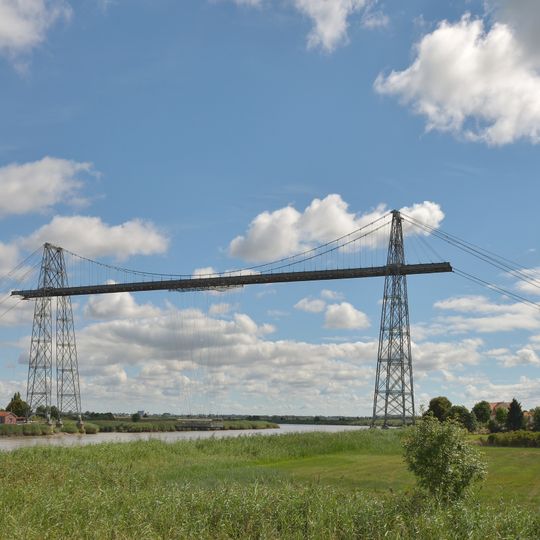
The Rochefort-Martrou Transporter Bridge has four lattice steel pylons, each 66.25 metres high, resting on eight masonry piles sunk 19.5 metres on the Rochefort bank and 8.5 metres on the Échillais side. A 175.5-metre truss girder links the pylons 50 metres above high water, and a nacelle suspended by crossed cables travels beneath it on 24 pairs of rollers, pulled by a cable wound on a ground-level winch.
Built between March 1898 and July 1900 by engineer Ferdinand Arnodin, the bridge replaced a ferry that could no longer handle traffic. It opened on 29 July 1900, cost 586,500 francs and could carry 14 tonnes. After the Second World War queues reached 500 metres, and it closed in 1967. Classified as a monument historique on 30 April 1976, it was restored from 1980 to 1994 and again from 2016 to 2020.
Jacques Demy filmed the opening scene of Les Demoiselles de Rochefort here between May and August 1966, with the nacelle used as a stage for a dance number; he wanted the bridge painted pink, but residents refused. The bridge also appears in Denis Malleval's 2014 TV film La Boule noire, adapted from Georges Simenon.
The nacelle runs only from April to the end of October, for tourists rather than daily commuters. A crossing lasts 75 seconds, not counting boarding and disembarking. Pedestrians, bicycles and mopeds are allowed; cars are not. The nacelle hangs from a trolley on the 175.5-metre girder, 50 metres above the highest water.
In 1966 Jacques Demy filmed the opening scene of Les Demoiselles de Rochefort on the bridge, with the nacelle used as a dance stage; he wanted it painted pink, but residents refused. The nacelle runs on 24 pairs of rollers along the deck, pulled by a cable wound on a drum winch in a Rochefort-side machinery house, electric since 1927.
The community of curious travelers
AroundUs brings together thousands of curated places, local tips, and hidden gems, enriched daily by 93,534 contributors worldwide.