Peyrepertuse, Medieval fortress in Duilhac-sous-Peyrepertuse, France
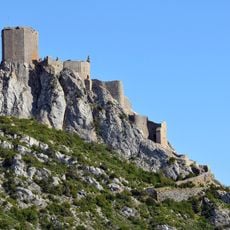
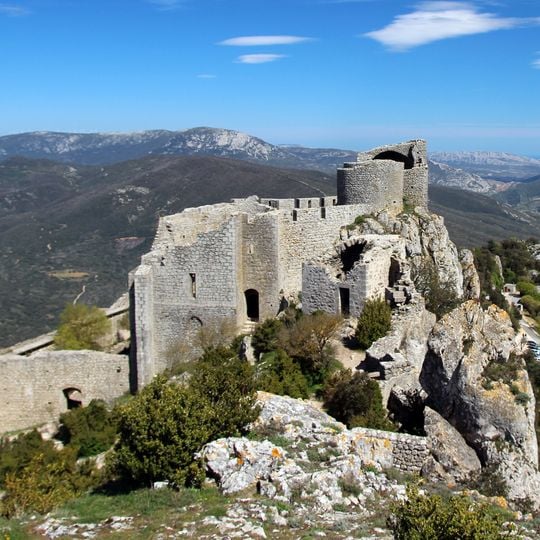
Peyrepertuse is a medieval castle ruin set high on a limestone ridge at around 800 meters elevation, divided into two distinct sections connected by a stone staircase. The upper citadel and lower fortress form a compact defensive complex adapted to the steep terrain.
The site was occupied from the 1st century BC, and a castle is first mentioned in 806. In 1239 Guillaume de Peyrepertuse ceded it to Louis IX after submitting; from 1242 the king reinforced it, and the Sant Jordi dungeon was built in 1250–1251. The Treaty of Corbeil in 1258 fixed the border just south of the castle.
The name Peyrepertuse comes from Occitan Pèirapertusa, "pierced stone", after the rock the castle stands on. The fortress is one of the "Five Sons of Carcassonne", with Quéribus, Puilaurens, Termes and Aguilar, and is nicknamed "Celestial Carcassonne" for its size. Visitors enter by the north gate and can still see the walkway of the lower enclosure, its slabs resting on corbels.
Access to the castle involves a winding path from the parking area that demands sturdy footwear and reasonable fitness. The visit requires climbing and descending uneven paths and stairs across several hundred meters of elevation change.
The castle's outline is compared to a huge stone ship, with a sharp prow at its tip where a stone-throwing engine once stood. The Sainte-Marie church, raised and fortified with arrow slits cut through its merlons, forms the old keep together with a dwelling of two stacked vaulted rooms. Four cisterns holding between 12 and 40 m³ supplied the garrison.
The community of curious travelers
AroundUs brings together thousands of curated places, local tips, and hidden gems, enriched daily by 93,477 contributors worldwide.