Château de Salignac, Medieval fortress in Salignac-Eyvigues, France.
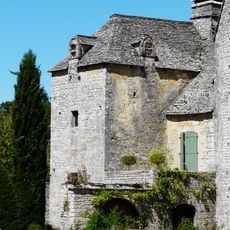
Château de Salignac is the former castle of the Salignac family in Salignac-Eyvigues, Dordogne, dating from the 11th to 15th centuries. Its pale tan and grey stone walls include a tall round tower with a conical grey roof and two connected square towers with steep pointed roofs, all pierced by small rectangular windows. Lower walls topped with vegetation and a ruined section with arched openings stand at the base, while a stone terrace wall with arched recesses, covered in ivy and shrubs, runs along the front.
The Salignac family is recorded from the late 10th century, and the first written traces of the castle date from the very early 11th century, when a square keep with flat buttresses and surrounding walls were built. In 1251 it appears as castrum de Salenhac in the testament of Raymond II, viscount of Turenne. During the Hundred Years' War it was repeatedly destroyed by English and French forces, and in the 15th century Antoine de Salignac led a major rebuilding campaign.
The name Salignac comes from the family that held the seigneurie from around 980, when Geoffroi de Salignac is recorded. The castle was a coseigneurie shared by noble families, with up to ten coseigneurs at once, and passed by the 1545 marriage of Jeanne de Salignac to Armand de Gontaut to the Gontaut-Salagnac line. Inside, four suits of armour stand beneath a red and gold pointed shield and two painted shields.
Visiting requires planning since opening hours vary by season and checking ahead is recommended. Access is limited for wheelchairs and strollers due to the uneven terrain and steep pathways.
The castle was a co-seigneurie shared by several noble families, with as many as ten co-seigneurs at once. The Lagarde-Salignac and Ferrières were among them, and noble houses were built inside the walls to lodge them and their households.
The community of curious travelers
AroundUs brings together thousands of curated places, local tips, and hidden gems, enriched daily by 94,553 contributors worldwide.