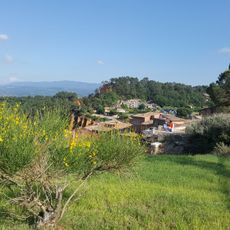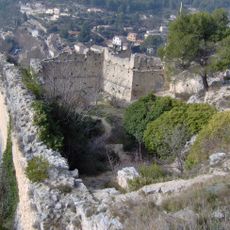
Mur de la peste, Protective stone wall in Vaucluse Mountains, France
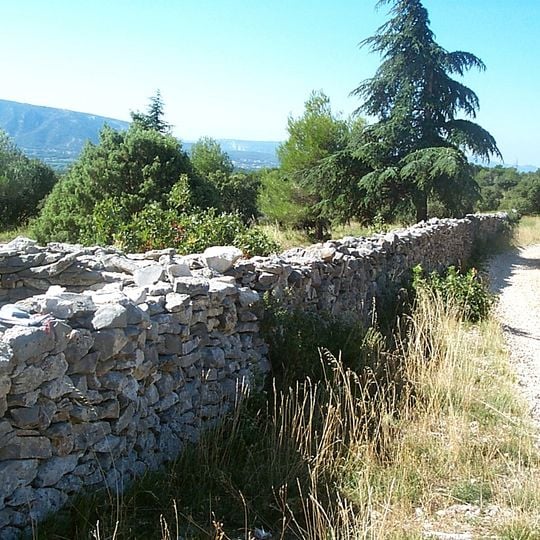
The Mur de la Peste is a stone wall extending roughly 27 kilometers through the mountainous landscape of Vaucluse with watchtowers spaced along its course. The structure joins stone blocks without mortar and follows the natural terrain of the region.
In February 1721 representatives of the Comtat Venaissin and the Kingdom of France agreed on a wall between Monieux and the Cabrières gorge; work, done largely by farm labourers, vagrants and children, lasted until July 1721. About a thousand papal soldiers then guarded it. The plague reached Avignon and the Comtat in late August 1721, so French troops took over the wall to protect the south from the north. The epidemic ended in the Comtat in January 1723.
The wall's name passed into local usage as the "mur de la peste", and the line it traces still marks the old border between the Comtat Venaissin and Provence. Near Méthamis, the health bureau required grape harvesters leaving the territory to return with a written attestation of where and how long they had worked.
Remains of the wall and its small guard huts can be seen at the Pas de Viguier in the north, at the Col de la Ligne (756 m) on the boundary between Murs and Méthamis, east of Fontaine-de-Vaucluse and near Cabrières d'Avignon. The line crosses high, uneven ground, so plan walks on foot along marked paths.
The wall was built mostly by farm labourers, vagrants and children, not skilled masons, because qualified builders were lacking in the difficult terrain. Work ran from February 1721 until July 1721. About a thousand papal soldiers then guarded it, but the plague reached Avignon and the Comtat Venaissin by late August 1721, and French troops took over the wall to protect the south from the north.
The community of curious travelers
AroundUs brings together thousands of curated places, local tips, and hidden gems, enriched daily by 93,550 contributors worldwide.