La Joselière dolmen, Neolithic burial site in Pornic, France.
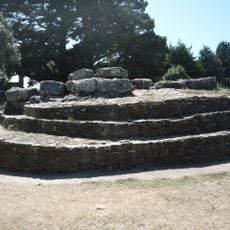
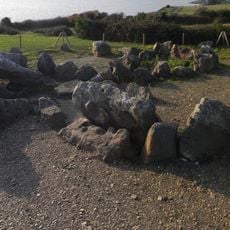
La Joselière dolmen is a transepted megalithic tomb in Pornic, set in a roughly square cairn about 13 to 14 metres on each side and up to 1.50 metres high at the centre. A 7.50-metre passage entered from the south-east opens onto two rectangular side chambers, about 2.6 by 1.9 metres each, and ends in a terminal space of 6 by 1.75 metres that may be one large chamber or two joined ones. The walls are of stacked flat grey and tan stones, with a large capstone over the entrance and a white quartz block outside it.
The monument was first recorded by W. C. Lukis, who drew its plan in 1868; Pitre de Lisle du Dreneuc described it in 1882 and Glyn Daniel cited it in 1939 as an example of a transepted tomb. It was classified as a historical monument in 1978 and underwent a rescue excavation and restoration in 1984-1985. The grave goods date its use to the 4th millennium BCE, contemporary with the Dissignac and Mousseaux tumuli, with a possible later Neolithic reoccupation.
The monument is also called dolmen du Pissot. The grave goods found in the two side chambers — three variscite and sericite beads, two flint arrowheads, flint tools, quartzite flakes and pottery fragments — place its use in the 4th millennium BCE, contemporary with the Dissignac and Mousseaux tumuli. A later reoccupation in the Final Neolithic is not excluded.
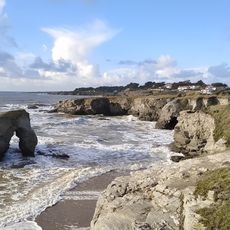
The cairn stands about a hundred metres from the sea, near the hamlet of la Birochère and the Joselière beach, southeast of Pornic in Le Clion sur Mer. It is reached on foot; the surrounding ground is grass and worn dirt, and the low stones of the mound can be walked around. The monument lies on the Route Bleue, whose marked circuit links eleven prehistoric sites of the Pays de Retz, including the tumulus of Dissignac and the dolmen du Pré d'Air a few hundred metres south.
The cupule-covered slab at the northeast corner near the entrance was already reused in the cairn when it was first built, so the markings predate the monument itself. The block of white quartz outside the east entrance is another detail to look for.
The community of curious travelers
AroundUs brings together thousands of curated places, local tips, and hidden gems, enriched daily by 93,439 contributors worldwide.