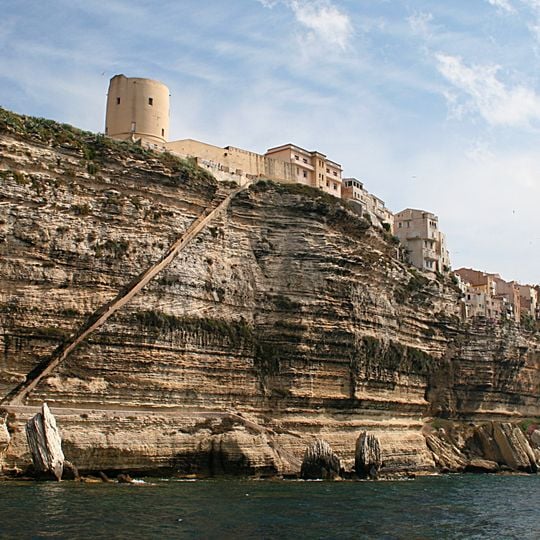
King of Aragon staircase, Historic staircase in Bonifacio, France
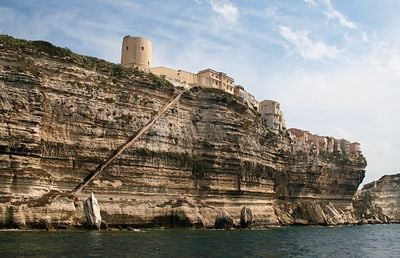
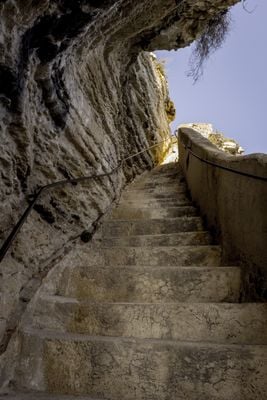
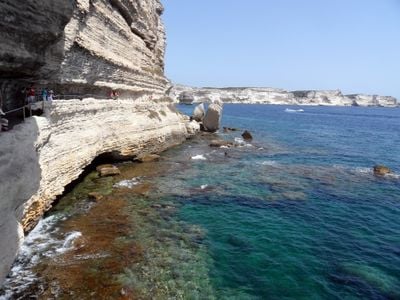
The King of Aragon staircase is a flight of 189 steps hewn by hand into the banded limestone cliff of Bonifacio, climbing at roughly 45°. A low border runs along one edge, and a dark metal handrail follows the parapet. At the bottom, a horizontal path about 15 metres above the sea leads to the Saint-Barthélemy cave and a second stairway.
Franciscan monks built the staircase over an extended period to create access to water and shelter from the town above. The name comes from the 1420 siege by Alfonso V of Aragon, who attacked the city and left his mark on local memory.
The staircase links the upper town to a natural freshwater spring inside the Saint-Barthelemy cave, a connection that shaped daily life for residents over centuries. Visitors can still sense how this vital water source influenced the layout and use of the settlement above.
The staircase is open to visitors in all seasons. Its 189 steps are cut at roughly 45 degrees into the limestone, and at the bottom a horizontal path about 15 metres above sea level leads to the Saint-Barthélemy cave and a second flight of steps. Wear closed shoes with grip; the descent is not suited to people with mobility difficulties.
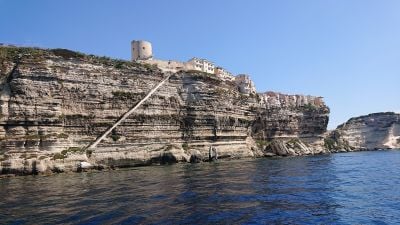
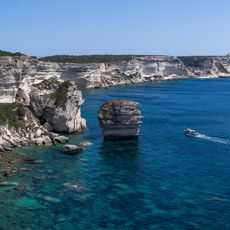
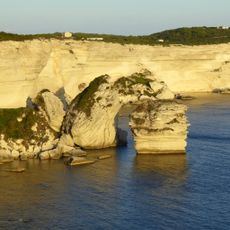
The staircase is cut into Bonifacio limestone, a rock called calcarénite. From a boat it reads as a dark oblique line over the full height of the cliff; up close it looks like a half-tube hollowed from the stone. The 189 steps climb at roughly 45 degrees.
The community of curious travelers
AroundUs brings together thousands of curated places, local tips, and hidden gems, enriched daily by 93,394 contributors worldwide.