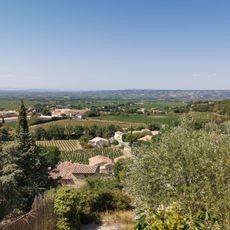
Dentelles de Montmirail, Mountain range in Vaucluse, France.
The Dentelles de Montmirail is a limestone range about 8 km long in Vaucluse, rising to the Crête de Saint-Amand at 722 m. Its three parallel ridges—the Chaîne du Clapis, the Dentelles Sarrasines and the Grande Montagne—are formed of Jurassic limestone tilted nearly upright and eroded into sharp crests. Pale grey rock outcrops break through wooded lower slopes above vineyards.
The range marks the western edge of the Monts de Vaucluse and the south-western end of the Baronnies. In Antiquity it served as a natural frontier between the Memini to the south and the Voconces to the north, and its oppida controlled the routes between the Rhône valley and Mont Ventoux. Two early Christian places of worship from the 7th century stood here, an abbey of nuns at the sources of the Trignon and the chapel of Saint-Hilaire. In the 14th century the popes at Avignon drew muscat wine from the massif's muscadières.
The range forms a natural setting for celebrated wine regions like Gigondas and Beaumes-de-Venise, where vineyard owners have cultivated Rhône wines for centuries. These mountains shape how locals see their land and connect the landscape directly to their winemaking traditions.
The area has many well-marked trails that let you hike, rock climb, or mountain bike at different levels of difficulty. Spring and autumn offer the best conditions, with mild temperatures and good visibility for exploring the landscape.
The massif's name comes from the French word for lace, dentelles, after the eroded rock spikes, while Montmirail derives from the Latin mons mirabilis, 'admirable mountain'. In Provençal it is Dentello de Mount-Mirai. The range also held two early Christian places of worship dated to the 7th century: an abbey of nuns at the sources of the Trignon and the chapel of Saint-Hilaire.
The community of curious travelers
AroundUs brings together thousands of curated places, local tips, and hidden gems, enriched daily by 94,657 contributors worldwide.