Orléans Cathedral, Catholic cathedral in Orléans, France
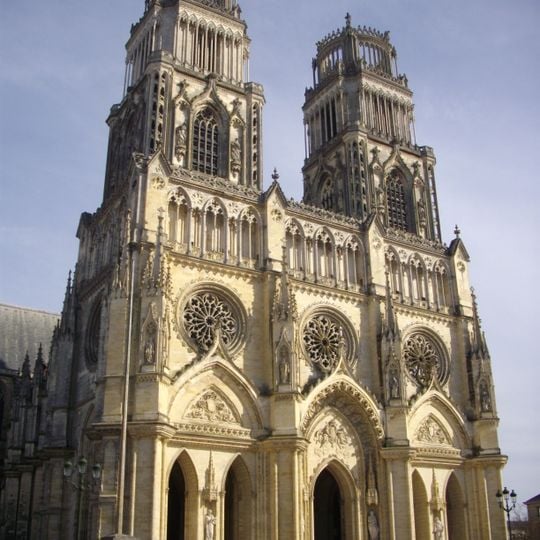
Orléans Cathedral is a Gothic structure in central Orléans featuring architectural elements that developed over multiple building phases spanning centuries. Its façade displays characteristic Gothic details including pointed arch windows and elaborate stone carvings on its main entrance and sides.
The cathedral's construction began in 1601 under King Henry IV, representing a continuation of earlier building efforts at the site. Completion of the full structure took until 1829, closing a construction process that spanned more than two centuries.
The name Sainte-Croix refers to the Holy Cross, and the cathedral's dedication is tied to the legend of Saint Euverte, who received a fragment of the True Cross from Emperor Constantine. The 1880 Cavaillé-Coll grand organ above the entrance is classified as a national monument and remains unaltered, while the smaller choir organ from 1846 was rebuilt in 1996.
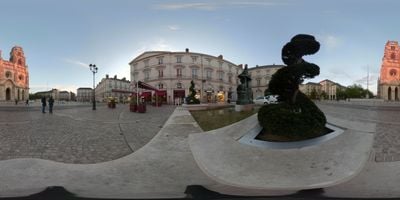
The west front opens onto place Sainte-Croix, with the three sculpted portals at ground level and the two 88-metre towers above; the 114-metre belltower rises over the crossing. The building is a classified monument historique and a basilica since 1855, so parts may be closed while restoration work continues. Look for the Cavaillé-Coll grand organ above the entrance.
The west façade seen today was completed in 1773, long after the Gothic nave, and mixes Italian Gothic and Classical elements. Its two symmetrical towers rise 88 metres, while the slender Gothic Revival steeple over the transept crossing reaches 114 metres, the highest point of the cathedral.
The community of curious travelers
AroundUs brings together thousands of curated places, local tips, and hidden gems, enriched daily by 93,453 contributors worldwide.