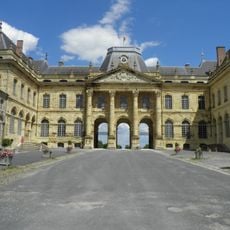
Synagoge, Protected religious building in Lunéville, France
The Synagogue of Lunéville stands at 5 rue Castara, set back from the street. Built in 1786 to plans by Augustin-Charles Piroux, it resembles a Louis XVI pavilion rather than a synagogue, with no Jewish symbol on its facade. The facade is of pink and tan stone blocks, with a large carved round window above a dark double door topped by three lines of Hebrew text.
Built in 1786, it was the second synagogue erected in the Kingdom of France since the expulsion of the Jews in 1394, after Phalsbourg (1772). Abraham Isaac Brisac, syndic of the Jews of Lunéville, initiated the project, and architect Augustin-Charles Piroux designed it. A house originally hid it from the street to meet the royal power's demand for discretion. It has been a classified historical monument since 15 July 1980.
The facade once read "Au Dieu d'Israël, par permission du roy de France, l'an 1785"; it now carries a Hebrew verse from 1 Kings 8:28, visible above the arched double door. The building has no Jewish symbol such as a Star of David, and its Louis XVI pavilion form follows the discretion required of a tolerated community.
The synagogue is located on Rue Castara in central Lunéville and is easy to reach on foot. Visitors should check ahead about visiting hours and respect the spaces reserved for religious services and community use.
The facade once carried a French inscription: "Au Dieu d'Israël, par permission du roy de France, l'an 1785", acknowledging royal permission. It has since been replaced by a Hebrew verse from the First Book of Kings (8:28). The building stands back from Rue Castara; at the time of construction it was hidden behind a house, later demolished.
The community of curious travelers
AroundUs brings together thousands of curated places, local tips, and hidden gems, enriched daily by 94,327 contributors worldwide.