Château de Lunéville, Royal castle in Lunéville, France
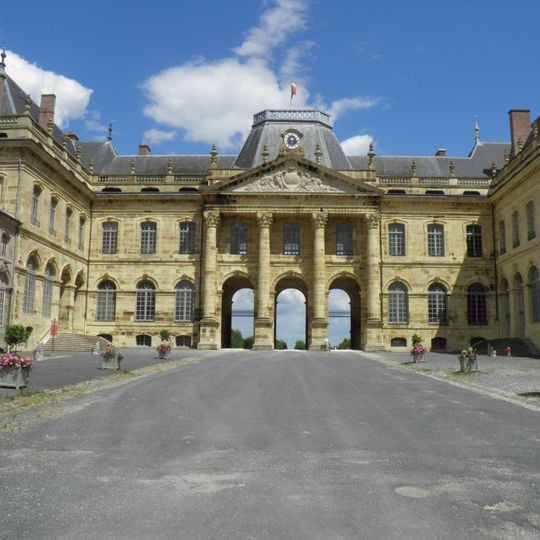
Château de Lunéville is a long stone palace of pale beige masonry with dark slate roofs, built around a central block and two wings. The central pavilion rises higher, with a clock, a triangular pediment on columns, and three tall arched openings at ground level; the wings have rectangular, arched, and square windows on three levels. The north wing was never built, leaving the plan asymmetrical.
Duke Leopold I rebuilt the medieval castle from 1703 to 1720 to plans by Pierre Bourdict, Nicolas Dorbay and Germain Boffrand, leaving the north wing unbuilt for lack of funds and giving the palace its asymmetrical form. His son François III ceded the duchy to Stanislas Leszczyński, who died there in February 1766, after which France annexed Lorraine.
Stanislas Leszczyński, the exiled King of Poland, received the duchy for life from his son-in-law Louis XV and lived at Lunéville until his accidental death in February 1766. He remodeled the interiors, and the 1753 plan names rooms such as the Chambre de Parade du Roy and the Cabinet du Conseil. After his death the duchy was annexed by France.
The castle is open daily except Tuesdays, with guided tours through restored rooms and temporary exhibitions about the region's past. Visiting allows access to historic interiors and current cultural offerings.
The gardens display mathematical precision in their layout, with water channels from the Vezouze River forming geometric patterns across the grounds. This ordered water system was a technical feat of its era.
The community of curious travelers
AroundUs brings together thousands of curated places, local tips, and hidden gems, enriched daily by 93,075 contributors worldwide.