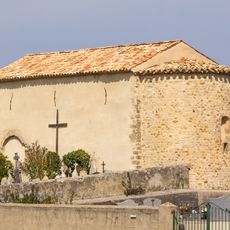
Église Notre-Dame-de-l'Assomption de Moustiers-Sainte-Marie, Romanesque church in Moustiers-Sainte-Marie, France.
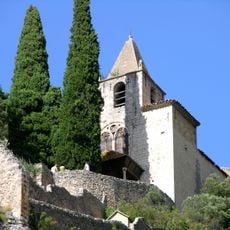
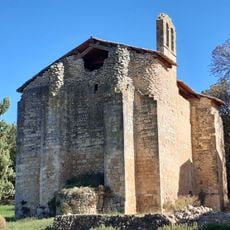
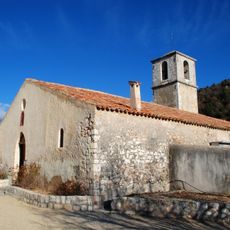
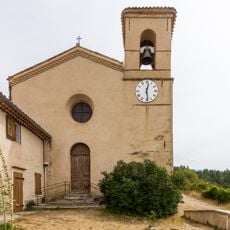
The Église Notre-Dame-de-l'Assomption is a 12th-century Romanesque church in Moustiers-Sainte-Marie, built of limestone tuff. Its 22-metre square bell tower rises in five tapering levels: the two lower ones are rough rubble masonry, the three upper ones carefully cut stone with twin arched openings, lesenes and Lombard bands. The nave has five bays under a pointed barrel vault; the Gothic choir was added in the 14th century.
Monks from Lérins founded the original monastery in the 5th century, but attacks from Saracens forced them to abandon it until the 11th century. This long gap between departure and return shaped how the building developed later.
The altar is a reused marble sarcophagus from the Gallo-Roman period, not a 4th-century carving of the Red Sea. The church's patron is Mary, to whom the central window of the choir apse is dedicated; its lower panel shows the pilgrimage chapel of Notre-Dame de Beauvoir above the village.
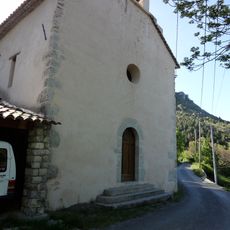
The church stands on the south side of the village, its bell tower rising beside the portal; the tower is 22 metres high and the south facade holds the entrance. The building is a classified monument historique since 18 March 1913. The village lies at the entrance to the Verdon gorge, so the approach is on foot through narrow streets.
The choir's off-axis position results from the 1336 Gothic reconstruction by Prior Pierre de Pratis, which replaced only the choir and left it out of line with the Romanesque nave. The 22-metre bell tower, shaken by the bells, was stabilized in the 17th century with iron ties and buttresses.
The community of curious travelers
AroundUs brings together thousands of curated places, local tips, and hidden gems, enriched daily by 94,444 contributors worldwide.