Musée d'Ennery, Asian art museum near Arc de Triomphe, Paris, France
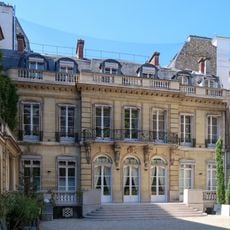
The Musée d'Ennery occupies a Second Empire mansion built from 1875 by architect Pierre-Joseph Olive at 59 avenue Foch, its light stone facade topped by a glass gallery with four columns, carved lions and urns. Inside, some 7000 Chinese and Japanese objects are shown in the founder's original display cases inlaid with mother-of-pearl.
Clémence d'Ennery began the collection in 1859 from family lacquer boxes and blue-and-white porcelain, moving it from rue de l'Échiquier into the villa built for her from 1875 by architect Pierre-Joseph Olive. In 1892 the couple planned to leave over 6,000 pieces and the mansion to the state, but a contested will delayed the bequest, validated only in 1901; the museum opened on 27 May 1908. Paul Pelliot was chief curator from 1930 to 1945, George Cœdès from 1947 to 1969.
The collection displays everyday objects from China and Japan spanning centuries, offering insight into how people in these cultures lived and worked. The arrangement reflects the personal taste of someone who spent decades gathering these pieces from across Asia.
The museum is accessible by guided tour only on Saturdays, and advance reservations are required for entry. Visitors should plan ahead as spots fill up quickly, and it helps to arrive on time for the scheduled tour start.
The display cases were carved by cabinetmaker Gabriel Viardot, whom Clémence d'Ennery helped launch and who also worked for Clemenceau. Their panels are inlaid with mother-of-pearl, and the cases are listed as monuments historiques along with the building since 1979.
The community of curious travelers
AroundUs brings together thousands of curated places, local tips, and hidden gems, enriched daily by 93,434 contributors worldwide.