Lac de Villefort, reservoir in France
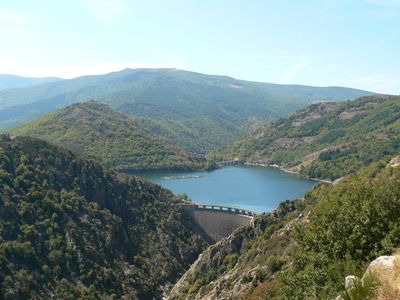
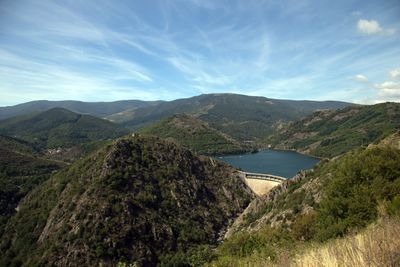
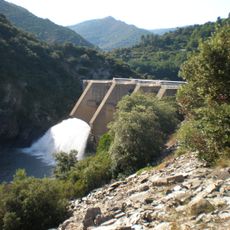
Lac de Villefort is the reservoir of the Villefort dam, which EDF built between 1957 and 1964 in a narrow valley northwest of Villefort in Lozère. The dam holds back 37 million cubic metres of water over 136 hectares at an elevation of 580 m. Its pale grey, slightly curved wall carries a low parapet walkway along the crest, with a small tower near the left abutment, and the water reaches back toward forested hills.
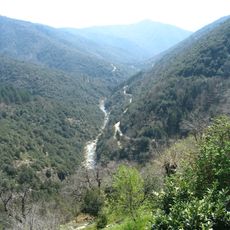
The lake was created in the 1950s through dam construction and began filling with water in 1964, transforming the Bayard valley. The submersion of the valley led to the flooding of several settlements, submerging historical structures including a 19th-century bridge that occasionally becomes visible when water levels drop.
The name refers to the village of Villefort nearby, which has deep roots in this mountain region. Today the lake has become a gathering place where locals and visitors come to spend time together, marking a shift from its original purpose as purely an engineering project.
A 7.3 km walking circuit runs around the lake, and the dam and its reservoir are listed as a protected site covering 340 hectares since 1972. Boating and water sports are regulated by a prefectoral order of 1 June 2016, and signs are maintained by the Villefort community of communes. Bathing and eating fish from the lake were banned by prefectoral order in 2019 because of toxic cyanobacteria.
The hamlet of Bayard, home to about thirty people, was expropriated and completely submerged when the reservoir filled. The Bayard vein of the old mining concession, worked until 1931, lies in that drowned village, and no archaeological survey was done before the banks were reshaped.
The community of curious travelers
AroundUs brings together thousands of curated places, local tips, and hidden gems, enriched daily by 93,456 contributors worldwide.