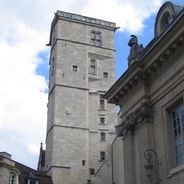
Château de Rosières, Medieval castle in Saint-Seine-sur-Vingeanne, France.
The Château de Rosières is a fortified manor whose main element is a square keep 21 m long and 13.50 m wide, with walls 1.80 m thick rising 19 m from the surviving moat to the roof. A four-sided hipped roof rests on original oak framing, and one corner turret survives of the three that once stood on the angles. A 14th-century quadrangular tower reinforces the south-west corner, and a 17th-century pavilion with wall paintings stands nearby.
The name Rosières appears in charters from the 11th century, then denoting a grange, a rural estate attached to a seigneurie. Eudes IV, Duke of Burgundy, granted the fief around 1321 to the Saint-Seine family, and Pierre de Saint-Seine built the domain until his death in 1350. In the 15th century the manor was fortified with the duke's consent, and the keep was finished in 1445. In 1682 Claude Bernard-Maillard acquired it and added a classical pavilion.
The chapel is dedicated to Saint George, and a resident priest once lived beside it. The dovecote is a pied colombier, its interior fitted with nesting niches called boulins. In the 17th-century pavilion, wall paintings show the castle as it stood in that century, alongside the arms of the Maillard-Bousquet couple.
The site operates as a bed and breakfast with rooms available for small to medium groups visiting during set daily hours. Guests should check in advance since its function as guest lodging may affect when visits are possible.
The name Rosières first appears in 11th-century charters meaning a grange, a rural estate attached to a lordship. The fortified gate tower, roofed with a pavilion roof, was once preceded by a drawbridge. The 17th-century pavilion keeps wall paintings showing the castle as it looked then, with the tall four-sided roof and lantern turret of the corner tower.
The community of curious travelers
AroundUs brings together thousands of curated places, local tips, and hidden gems, enriched daily by 94,497 contributors worldwide.