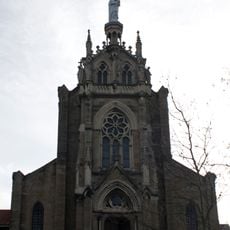
Abbey of Valbenoîte, Religious building in Saint-Étienne, France.
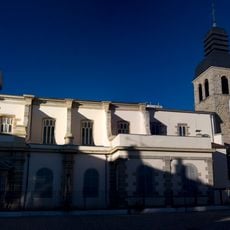
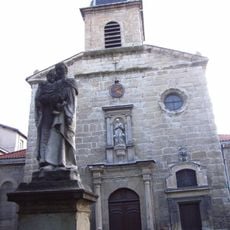
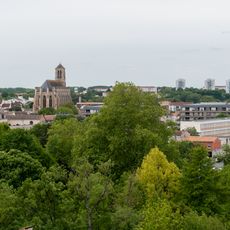
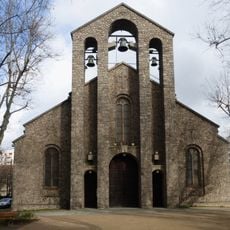
The Abbey of Valbenoîte, now the church of Notre-Dame de Valbenoîte, has a 19th-century facade with a triangular pediment, a rose window and a porch on four square columns, beside a three-level square tower. Inside, the nave and side aisles are separated by pointed and rounded arches on massive rectangular pillars, with a rounded apse at the far end.
The building was founded in 1184 following a dispute between the Count of Forez and the Archbishop of Lyon, with its first stone laid in 1222. Over the centuries, it was destroyed and rebuilt several times, allowing it to adapt to different periods.
The church keeps a Cavaillé-Coll organ built in 1859 and later modified several times. The abbey was the burial place of the lords of Jarez and Durgel, lords of Saint-Priest-en-Jarez and Saint-Chamond. Since 2022 the parish has been joined with Saint-Étienne under the name Saint-Étienne-Saint-Benoît.
The church stands on Place de l'Abbaye in the Valbenoîte district, near the Furan. The floor was raised about 1.80 m around 1850 to protect the interior from the river's floods, so the nave sits above street level. The building is inscribed as a monument historique, except for the 19th-century facade and bell tower.
The floor was raised about 1.80 m around 1850 to protect the church from flooding by the Furan, the stream beside which the abbey was founded in 1184. The Cavaillé-Coll organ, built in 1859, has been modified several times since.
The community of curious travelers
AroundUs brings together thousands of curated places, local tips, and hidden gems, enriched daily by 94,036 contributors worldwide.