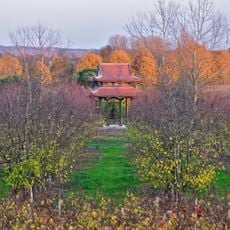
Saussignac AOC, Wine appellation in Dordogne, France
Saussignac AOC covers four communes on the left bank slopes of the Dordogne: Saussignac, Razac-de-Saussignac, Monestier and Gageac-et-Rouillac. Its vines grow on low-gradient hillsides of soft Fronsadais sandstone, Castillon limestone and Agenais molasse, where stone and clay alternate within a single plot. Rows run across the slope, with a bare brown patch breaking the green in places. Planting is fixed at 5,000 vines per hectare, and irrigation is forbidden.
In 1934 a Gageac-et-Rouillac grower lost his case at the Bergerac court against the Monbazillac producers, whose appellation excluded his zone. A decree of 9 October 1956 let growers add "Côtes de Saussignac" to the name bergerac, extended in 1967 to côtes-de-bergerac. Saussignac became an AOC in its own right by decree of 28 April 1982, with the specification revised in 2005, 2009, 2011 and 2017.
The name comes from the commune of Saussignac. The appellation's specification cites a line attributed to Rabelais in Pantagruel (1532) about "grand buveurs de saussignac", but this passage cannot be found in his work. The wine is a sweet white made from Sémillon affected by noble rot, and chaptalization is forbidden.
Visitors can explore the wineries of this region and discover regional dishes like Périgord chicken or fish in sauce. The sweet wines here pair well with such meals and desserts.
The rules of this appellation prohibit chaptalization, meaning all sweetness comes naturally from grapes affected by the noble rot fungus Botrytis cinerea. This natural process is the key to the complex flavors of these wines.
The community of curious travelers
AroundUs brings together thousands of curated places, local tips, and hidden gems, enriched daily by 94,960 contributors worldwide.